
OD vs OS: Understanding the Differences in Ocular Prescription Terms
OD vs OS: Understanding the Differences in Ocular Prescription Terms
When we examine an eye prescription, we often encounter a series of abbreviations and terms that may initially seem cryptic. Among the most common are "OD" and "OS," which are abbreviations stemming from classical Latin. If you have searched what is od, od means what eye, or od and os meaning, these terms simply help identify which prescription belongs to each eye.
OD stands for "oculus dexter," referring to the right eye, while OS signifies "oculus sinister," representing the left eye. Eye care professionals use these terms to designate prescriptions for each eye, ensuring that any vision impairments are accurately addressed. In plain terms, the medical abbreviation for od means the right eye, and os eyes meaning refers to the left eye.
Determining the correct lens power and type is essential for correcting vision impairments, which can range from myopia and hyperopia to astigmatism.
The precise values prescribed for OD and OS help optometrists and ophthalmologists provide patients with the appropriate corrective lenses. Whether for glasses or contact lenses, understanding these notations is crucial for patients to make informed decisions about their eye care, especially when reviewing an od eye prescription.
Understanding eye prescriptions allows individuals to actively participate in the discussions and decisions regarding their visual health, especially when reading terms such as eye os od, eyesight od os, or eye os and od on a prescription form.
Key Takeaways
- OD and OS are terms from Latin that refer to the right eye and left eye, respectively.
- These abbreviations help eye care professionals specify prescriptions for each eye.
- Comprehending prescription notations is vital for choosing suitable corrective lenses.
Understanding Eye Prescriptions

When we look at an eye prescription, we're seeing a set of parameters that correct our vision based on individual eye needs. It's crucial to understand each component to ensure proper eyewear selection.
Reading Glasses Prescription
The glasses prescription provides a blueprint for creating lenses that compensate for refractive errors in our eyes, such as nearsightedness, farsightedness, or astigmatism. If you see glasses prescription od, od glasses prescription, or glasses prescription od listed online, it is referring to the OD line used for the right eye.
To read a glasses prescription, it's important to recognize the common terms and numbers that indicate lens power in diopters, which denote the level of correction needed. This is also why many people search what is od and os in eye prescription when first reviewing their paperwork.
Interpreting OD, OS, and OU
The abbreviations OD, OS, and OU are Latin terms used to denote eyes. You may also see the phrase od os ou when learning how both individual-eye and both-eye measurements are written:
- OD (Oculus Dexter): Right Eye
- OS (Oculus Sinister): Left Eye
- OU (Oculus Uterque): Both Eyes
When comparing OD vs OS in eye prescriptions, we're often looking at differences in vision needs between both eyes. Each eye may have distinct prescriptions due to varying degrees of refractive error. Searches like od vs os eyes and od vs os eye usually refer to this right-eye versus left-eye comparison.
Sphere (SPH) and Cylinder (CYL) Explained
In an eye prescription, the SPH and CYL values serve different functions:
- Sphere (SPH): This indicates the lens power, measured in diopters, needed to correct nearsightedness or farsightedness. A positive number signifies farsighted correction, while a negative number is for nearsighted correction.
- Cylinder (CYL): This number measures the degree of astigmatism in the eye, which is an irregular curvature of the cornea causing blurred vision. Like SPH, it's measured in diopters and can also be positive or negative.
In essence, understanding these parameters helps us interpret how to correct our individual visual impairments with the correct eyewear.
OD and OS: Right Eye vs Left Eye
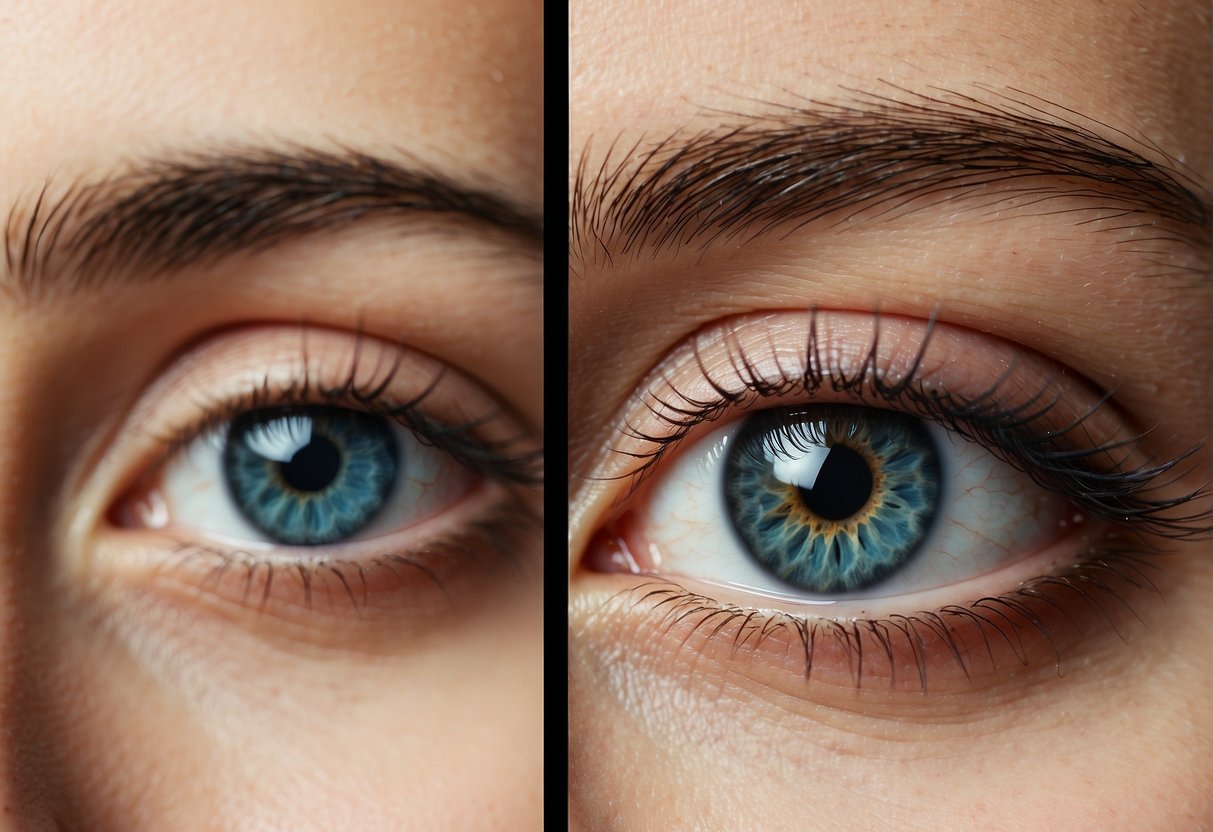
In the context of eye prescriptions, it's crucial to understand the meaning of OD and OS as they refer to the right and left eyes respectively.
Is OD Right Eye?
OD stands for "oculus dexter," the Latin term for the right eye. When you see OD on a prescription, you can be certain it indicates the parameters related to the correct vision correction for your right eye. So, if you are wondering is od right or left eye, OD is the right eye.
Is OS Left Eye?
OS translates to "oculus sinister" and is used to denote the left eye. Prescriptions will use OS to specify the unique corrective requirements for your left eye. If you are asking is od left or right eye or is od left eye or right eye, OD is right, and OS is left.
How Prescriptions Vary Between Eyes
Our right and left eyes can have different visual acuity and may require lenses with varying prescription strengths. This is often reflected clearly in a prescription:
| Eye (Latin Abbreviation) | Abbreviation Meaning | Prescription Example |
|---|---|---|
| OD (oculus dexter) | Right eye | -2.00 SPH |
| OS (oculus sinister) | Left eye | -2.50 SPH +1.25 CYL |
The numbers vary, showing different eye prescriptions for each eye, with OD for the right eye and OS for the left eye. It's not uncommon to encounter an additional term, OU, which means "oculus uterque" referring to both eyes together when the prescription is the same for both.
Determining Lens Power and Type

In eyeglass prescriptions, the key components such as sphere (SPH), cylinder (CYL), and prism are fundamental to tailoring lenses that correct vision precisely. It's essential to understand these terms to ensure optimal vision correction.
Understanding Sphere in Prescriptions
Sphere (SPH) in a prescription indicates the lens power, measured in diopters, needed to correct nearsightedness or farsightedness. A "plus" sign means a patient is farsighted, while a "minus" sign denotes nearsightedness. The higher the number, the stronger the prescription lens required.
For example, an SPH of +2.00 means a farsighted correction of 2 diopters, while -2.00 indicates the opposite.
Astigmatism and Cylinder Values
Cylinder (CYL) values correct astigmatism, which occurs due to an irregularly shaped cornea. These values represent the amount of lens power required for astigmatism correction. A prescription might list a CYL as -1.50, indicating that 1.5 diopters are necessary to correct the distortion caused by astigmatism.
| CYL Power | Astigmatism Correction |
|---|---|
| -0.25 | Minimal |
| -1.00 | Moderate |
| -2.00 | Significant |
Prism and Base in Eyeglasses
Prism correction is used to fix alignment issues in the eyes, aiding in the treatment of conditions like double vision. The prism value is denoted in prism diopters, and the base is the direction the thickest edge of the prism faces in the glasses. Base directions can be up, down, in (towards the nose), or out (towards the ear).
- Prism value: 1.5pd Base up - indicating a prism of 1.5 prism diopters with base facing upwards.
Lens power and type are integral in ensuring that eyeglasses provide precise vision correction. A detailed understanding of sphere, cylinder, and prism values is essential for interpreting prescriptions and fabricating the right lenses.
Vision Impairments and Legal Blindness
In this section, we focus on the specifics of legal blindness, including the definitions and criteria used to classify individuals as legally blind, and how it relates to the scale of common vision impairments such as myopia and hyperopia.
Legally Blind: Definitions and Prescriptions
According to the law, we consider a person to be legally blind when their best-corrected visual acuity is 20/200 or worse in their better eye. This means even with corrective lenses, their vision measures at a level where they can see at 20 feet what a person with typical vision can see at 200 feet.
A prescription that indicates legal blindness may include a diopter measurement of -2.50 or higher in myopia, or +2.50 or higher in hyperopia; however, these numbers can vary. Legally blind prescription often involves high diopter lenses to correct vision as much as possible.
Myopia and Hyperopia Scale
The scale of myopia and hyperopia can be explained as follows:
- Myopia (nearsightedness): A condition where objects up close appear clearly, while objects far away are blurred. Here are common prescriptions and their corresponding visual acuity:
| Prescription (- Diopters) | Visual Acuity |
|---|---|
| -0.50 to -3.00 | Mild Myopia |
| -3.00 to -6.00 | Moderate Myopia |
| -6.00 and higher | Severe Myopia |
- Hyperopia (farsightedness): A condition where distant objects may be seen more clearly than objects that are near. Here are common prescriptions and their levels of hyperopia:
| Prescription (+ Diopters) | Visual Acuity |
|---|---|
| +0.50 to +3.00 | Mild Hyperopia |
| +3.00 to +6.00 | Moderate Hyperopia |
| +6.00 and higher | Severe Hyperopia |
It is important to note that the diopter scale is not a direct indicator of legal blindness. The distinction of legal blindness is typically centered around the 20/200 visual acuity marker rather than the diopter prescription alone.
Prescription Measures for Specific Conditions

When addressing vision issues through corrective lenses, we tailor prescriptions to the individual's specific ocular needs. These measures ensure optimal vision correction and comfort.
Astigmatism Prescriptions
Astigmatism is a condition where the cornea has an irregular shape, leading to blurred vision. Our prescriptions for astigmatism include a specific measure called cylinder (CYL), denoted in diopters (D), which compensates for the corneal irregularity.
The axis, measured in degrees, indicates the orientation of the astigmatism. In the table below, you can see how astigmatism glasses are prescribed:
| CYL (Diopters) | Axis (Degrees) | Prescription Type |
|---|---|---|
| -1.00 to -3.00 | 0 to 180 | For moderate astigmatism |
| -0.25 to -0.75 | 0 to 180 | For mild astigmatism |
Astigmatism prescriptions differ from normal prescriptions, which often do not include a CYL measurement.
Presbyopia and NV-ADD
Presbyopia is an age-related condition characterized by difficulty focusing on close objects. To correct this, we include an "Add" value in the prescription, referred to as NV-ADD, which stands for near vision addition. This is the additional power needed to aid in close-up tasks such as reading. Below is an example of how NV-ADD is typically denoted in a prescription:
- OD (Right Eye): +2.50 sph +1.00 add
- OS (Left Eye): +2.00 sph +1.00 add
The "add" part of the prescription is universally applied to both eyes and indicates the extra focusing power needed for near vision. The sph (sphere) denotes the primary correction for distance vision while the add represents the increased magnification necessary for close work.
Glasses and Contact Lenses
When discussing corrective eyewear, we consider both the visual requirements of individuals and the precision needed in optical prescriptions. Our focus here is on how these prescriptions differ between glasses and contact lenses, as well as understanding the strength required for reading glasses using eye charts.
Prescription Differences for Contacts
Prescriptions for glasses and contact lenses are not interchangeable. For contacts, the prescription accounts for the lens being placed directly on the eye, thus requiring different parameters. This is why contacts od vs os can be slightly different from what appears on a glasses prescription.
OD refers to 'oculus dextrus,' the right eye, while OS denotes 'oculus sinister,' the left eye. These terms specify the corrections needed for each eye.
Contact lens prescriptions additionally include measurements for base curve (BC) and diameter (DIA), which determine how the lens fits. Here's an example of how the prescription differences might look:
| Prescription Type | OD (Right Eye) | OS (Left Eye) |
|---|---|---|
| Glasses | -2.00 Sph | -2.50 Sph |


