



How to Measure Pupillary Distance: A Step-by-Step Guide
Posted by Team Debby on 3rd Feb 2024
Ordering glasses online is easier than ever — but there’s one little number that can make or break your perfect fit: pupillary distance (PD). This simple measurement ensures your lenses line up with your eyes, giving you crisp vision and all-day comfort.
If you’ve ever wondered how to measure PD at home (without fancy tools), you’re in the right place. Let’s walk through the essentials.
What Is Pupillary Distance (PD)?
Pupillary distance is the space between the centers of your pupils, measured in millimeters. Think of it as the blueprint that tells your lenses exactly where to sit.
- Binocular PD: One number showing the distance between both pupils (average adult range: 54–74 mm).
- Monocular PD: Two numbers, measuring each eye separately (right pupil to nose bridge + left pupil to nose bridge). This is extra important for progressive or bifocal lenses.
Why it matters: If your PD is off, your lenses won’t match your line of sight. That can lead to blurry vision, eye strain, or even headaches.
Applying Pupillary Distance to Everyday Clarity
As the article explains, measuring pupillary distance helps ensure that the optical center of each lens lines up with where your eyes naturally focus. Readers made with this alignment in mind can provide more stable clarity and reduce the subtle strain that comes from off-center lenses. The options below show how careful positioning translates into more comfortable, accurate vision for close work.
Tools You Can Use to Measure PD
You don’t need a professional setup to get an accurate PD. Here are your options:
- Millimeter Ruler + Mirror – Quick DIY method, no tech required.
- Printable PD Tool – DebbySpecs offers a free downloadable ruler (perfect for at-home measuring).
- Pupillometer – A professional tool used by optometrists (very precise, but less common at home).
- Smartphone Apps – Many apps guide you through the process with your phone’s camera and a credit card for scale.
Pro Tip: If you use an app, double-check your results with a manual method for extra confidence.
Step-by-Step: How to Measure PD at Home
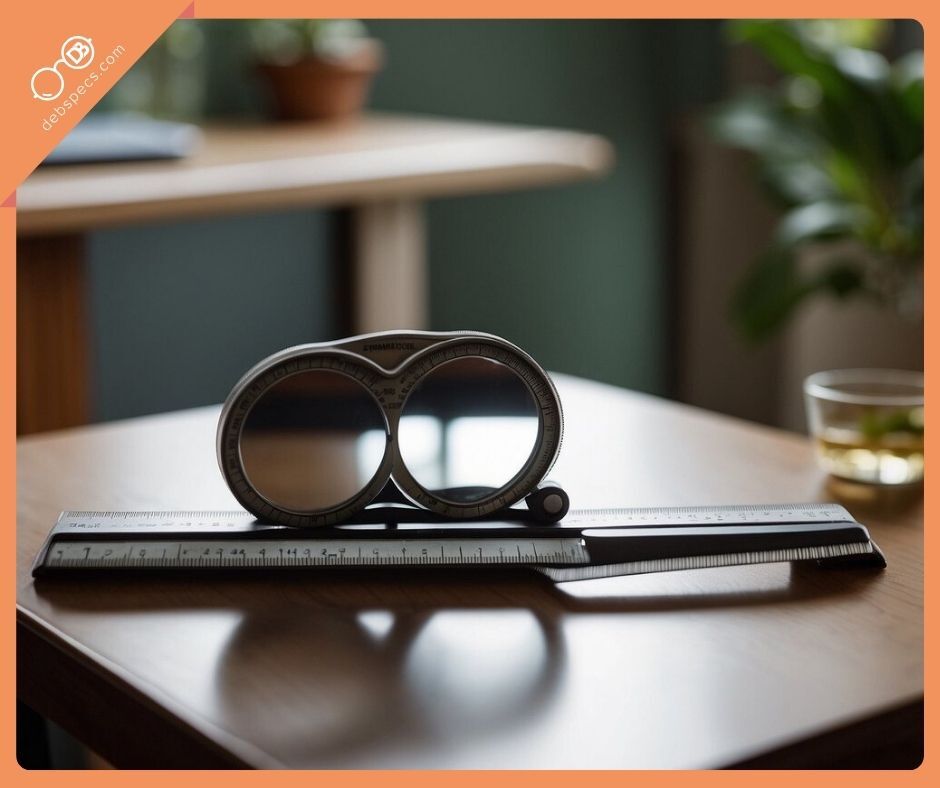
- Get Ready: Stand about 20 inches from a mirror, with good lighting.
- Hold Your Ruler: Place a millimeter ruler flat across the bridge of your nose.
- Line It Up: Close your right eye. Align the “0” mark of the ruler with the center of your left pupil.
- Measure Across: Open your right eye, close your left, and note the measurement at the center of your right pupil.
- Record It: That number (in millimeters) is your PD.
If your measurement looks like two numbers (e.g., 31/30.5), you’ve found your monocular PD. This gives a more custom fit, especially for multifocal lenses.

How to Interpret Your PD
- Single Number (e.g., 62 mm): Binocular PD — perfect for most single-vision lenses.
- Two Numbers (e.g., 31/30.5): Monocular PD — best for bifocals and progressives.
- Range Check: Most adult PDs fall between 54–74 mm. If you’re way outside that, recheck your measurement or consult an optician.
When to See a Professional
DIY PD works for most readers and single-vision glasses. But it’s worth visiting an optician if:
- You’re ordering progressive or bifocal lenses (precision is key).
- You have high-powered prescriptions.
- You notice persistent headaches, eyestrain, or blurred vision with your new glasses.
An expert can measure PD with specialized tools and ensure your lenses are perfectly aligned.
How PD Affects Frame and Lens Choices
- Frames: A wider PD calls for wider frames; a narrow PD suits narrower ones. Always check product specs.
- Single-Vision Lenses: PD keeps the optical center in line with your pupils.
- Progressives & Bifocals: PD ensures the reading, intermediate, and distance zones are aligned.
- Reading Glasses: A precise PD makes the “reading window” more comfortable.
In short: the right PD = lenses that feel like they were made just for you.

Troubleshooting PD-Related Issues
If your glasses don’t feel quite right, PD could be the culprit.
Common signs of incorrect PD:
- Headaches soon after wearing new glasses
- Eyestrain during reading or screen use
- Blurry vision, even with the correct prescription
What to do:
- Compare your PD with past prescriptions.
- Re-measure at home to double-check.
- If discomfort continues, consult your optician for a professional re-check.
Myth vs. Fact: Pupillary Distance
- Myth: Only optometrists can measure PD.
Fact: You can measure it yourself at home with simple tools. - Myth: A tiny mistake won’t matter.
Fact: Even being off by 1–2 mm can cause eyestrain, especially with progressives. - Myth: PD never changes.
Fact: PD is stable in adulthood, but frame size and lens type can affect how it’s applied.

TL;DR
- PD (pupillary distance) = the space between your pupils, in mm.
- It ensures lenses align correctly with your eyes.
- You can measure it at home with a ruler, printable tool, or app.
- Accurate PD = clearer vision + less strain.
- For progressives, bifocals, or high prescriptions, see a pro.
FAQs About Pupillary Distance
Q: Can I measure PD at home without tools?
A: You’ll need at least a ruler (or our printable PD card). Apps make it easier, but you can’t do it with “just your eyes.”
Q: Is my PD listed on my prescription?
A: Sometimes, yes. If not, call your optometrist — they usually keep it on file.
Q: What’s a “normal” adult PD?
A: Most adults fall between 54–74 mm. Kids typically have a narrower PD.
Q: How accurate does my PD need to be?
A: Within 1–2 mm is usually fine for single-vision lenses. Progressives and bifocals need exact precision.
Q: Can my old glasses help me find my PD?
A: Yes! Some labs etch the PD inside the lenses. Otherwise, use a ruler to measure across the lenses at pupil level.
✨ At DebbySpecs, we make it easy to shop stylish, affordable readers that fit your face and your PD — so you can see clearly and look fabulous, every time.