


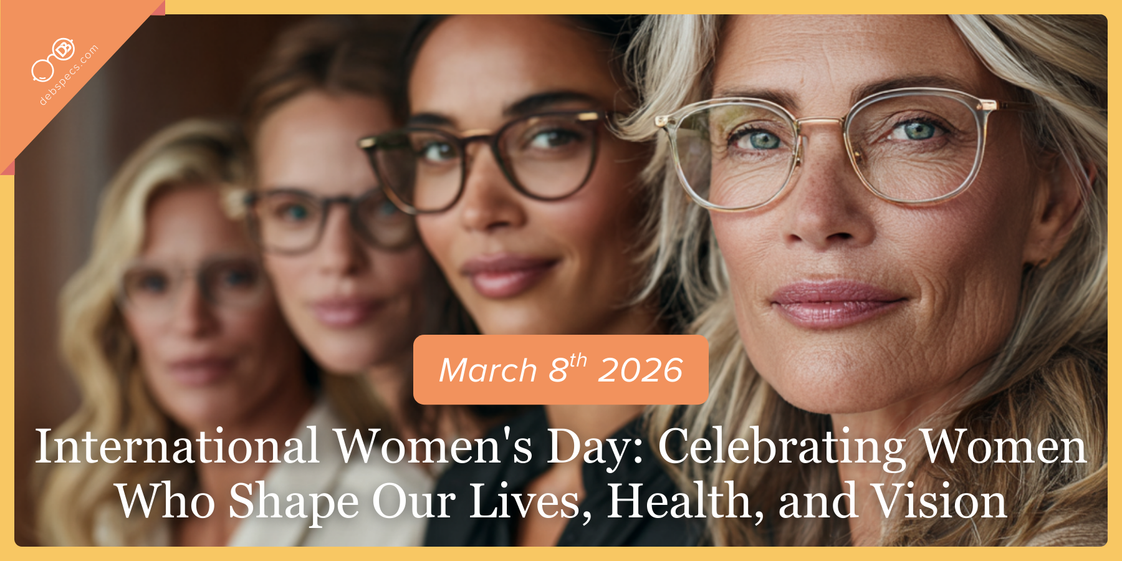
International Women's Day: Celebrating Women Who Shape Our Lives, Health, and Vision
Posted by Team Debby on 14th Feb 2026
TL;DR: International Women's Day, celebrated annually on March 8th, honors women's achievements and advocates for gender equality worldwide. From labor activists in the early 1900s to today's leaders in healthcare, vision care, and beyond, women have shaped society despite facing significant barriers. This day reminds us to celebrate progress, recognize ongoing challenges, and honor the everyday women who continue to make extraordinary contributions to our communities and lives.
What Is International Women's Day?
International Women's Day is a global observance held on March 8th that celebrates women's social, economic, cultural, and political achievements while advocating for gender equality and women's rights. It's both a celebration of progress and a call to action for continued advancement toward equality in all areas of life.
The day gives focus to critical issues including equal rights, reproductive rights, workplace equality, violence prevention, and access to education and healthcare. More than just a single day, it represents an ongoing movement that connects people worldwide in the shared goal of creating a more equitable society for women and girls.
Readers Designed for the Way You Move Through the Day
As we reflect on the many roles women step into each day, clear and comfortable vision quietly supports it all. The right readers aren’t just about magnification — they’re about confidence, balance, and ease as you transition from screen time to conversations to moments of rest. Thoughtfully designed frames and lenses help bring that clarity into everyday life, without asking you to compromise on style or comfort.
Why Does International Women's Day Still Matter Today?
Despite significant progress over the past century, gender equality remains unfinished work. Women currently hold only 64 percent of the legal rights that men have worldwide, and at the current pace of change, it would take 286 years to close existing legal protection gaps.
International Women's Day matters because it:
Recognizes that women still face systematic disadvantages in fundamental areas including work, healthcare, property rights, family law, and retirement
Celebrates the remarkable progress women have made in fields once closed to them, from medicine to business leadership
Honors the everyday contributions of women in families, communities, and professions that often go unrecognized
Provides a platform for raising awareness about issues like gender-based violence, wage gaps, and limited access to education and healthcare in many parts of the world
The 2026 theme, "Give To Gain," emphasizes the power of reciprocity and support. When people, organizations, and communities give generously, opportunities and support for women increase. Giving is not a subtraction, it's intentional multiplication. When women thrive, we all rise..
How Did International Women's Day Begin and How Is It Celebrated Today?
International Women's Day emerged from labor movements in early 20th century North America and Europe. The first National Woman's Day was observed in the United States on February 28, 1909, organized by the Socialist Party of America. In 1908, thousands of women had marched through New York City demanding better working conditions, voting rights, and an end to discrimination.
German socialists Clara Zetkin and Luise Zietz proposed establishing an annual International Women's Day at the 1910 International Socialist Women's Conference in Copenhagen. The first International Women's Day was celebrated in 1911 across Austria, Denmark, Germany, and Switzerland, with more than a million women participating in marches and meetings.
The date of March 8 became permanently associated with the day after Russian women staged a strike for "bread and peace" on March 8, 1917, protesting food shortages and World War I. This demonstration helped spark the Russian Revolution. The United Nations officially recognized International Women's Day in 1977, inviting member states to observe it annually.
Today, International Women's Day is celebrated through:
Marches, rallies, and demonstrations advocating for women's rights and equality
Educational events, conferences, and workshops highlighting women's achievements and ongoing challenges
Recognition ceremonies honoring women leaders in various fields
Support for women-owned businesses and women-focused charitable organizations
Social media campaigns sharing stories of women's achievements using hashtags like #ForAllWomenAndGirls
In many countries, International Women's Day is a national holiday. In others, it serves as a day of reflection, celebration, and renewed commitment to gender equality.
How Have Women Shaped Society Across Different Fields?
Women's contributions extend across every facet of society, though these contributions have often been overlooked or undervalued. From family caregivers to scientific researchers, from community organizers to business innovators, women have consistently worked to improve the world around them.
In education, women have served as teachers, administrators, and advocates for accessible learning, shaping generations of students while often fighting for their own right to education. In science and research, women have made groundbreaking discoveries despite facing significant barriers to entry and recognition in their fields.
Women have been central to social movements advocating for civil rights, environmental protection, labor reform, and healthcare access. They've built organizations, led campaigns, and created networks of support that have transformed communities.
In families and communities, women have provided essential care work that sustains society, from raising children to supporting aging parents, from organizing neighborhood initiatives to volunteering for causes they believe in. This work, though fundamental, has historically been undervalued and unpaid.
What Have Women Contributed to Healthcare and Medicine?
Women have practiced medicine since ancient times, often as herbalists, midwives, and caregivers, despite being excluded from formal medical training for centuries. Their perseverance in the face of discrimination has transformed healthcare and saved countless lives.
Elizabeth Blackwell became the first woman to earn a medical degree in the United States in 1849, graduating from Geneva Medical College despite facing considerable opposition. She went on to establish the New York Infirmary for Women and Children in 1857, which not only provided care to underserved communities but also trained other women to become physicians.
Rebecca Lee Crumpler challenged both gender and racial barriers to become the first African American woman to earn a medical degree in 1860. Virginia Apgar revolutionized neonatal care in 1952 by creating the Apgar Score, a simple system for evaluating newborn health that remains standard practice in delivery rooms worldwide.
Women have also advanced medical research in profound ways. Marie Curie's groundbreaking work on radioactivity led to developments in radiation therapy for cancer treatment. Rosalind Franklin's work with X-ray crystallography provided critical insights into DNA structure that laid the groundwork for modern genetics.
Today, women represent approximately 70 percent of the global healthcare workforce, serving as physicians, nurses, public health experts, and researchers who continue to advance medical knowledge and patient care.
How Have Women Advanced Vision Care and Eye Health?
Women have made remarkable contributions to vision care despite entering the field when it was almost exclusively male-dominated. These pioneers not only advanced the science of vision but also improved access to eye care for underserved populations.
Dr. Isabel Hayes Chapin Barrows became the first woman to practice ophthalmology and perform eye surgery in the United States. After earning her medical degree in 1869, she studied under renowned Professor Johann Friedrich Horner in Zurich, Switzerland, before returning to open a private ophthalmology practice in Washington, DC. She also became the first female professor at a medical school, teaching at Howard University from 1870 to 1873.
Dr. Gertrude Stanton became the first woman licensed to practice optometry in the United States around 1899 in Minneapolis, Minnesota. She not only built her own practice but also advocated for other women entering the field and started her own optical business run entirely by women.
Dr. Patricia Bath revolutionized cataract treatment and became the first African American female physician to receive a medical patent. In 1986, she invented the Laserphaco Probe, which transformed cataract surgery and restored vision to millions of patients worldwide. Throughout her career, Bath remained committed to combating preventable blindness and addressing healthcare disparities in underserved communities.
Dr. Alice McPherson pioneered groundbreaking retinal treatments, including cryotherapy and scleral buckling procedures. She advocated for using laser photocoagulation to treat diabetic retinopathy when it was still controversial, a treatment now widely accepted and used.
Today, women make up nearly half of all practicing optometrists in the United States, compared to just 3 percent a century ago. Women now account for approximately 71 percent of optometry school enrollments, ensuring that the field continues to benefit from diverse perspectives and experiences.
How Do Women Lead in Business and Everyday Life?
Women's leadership extends far beyond traditional corporate roles. While women continue to break barriers in executive suites and boardrooms, they also demonstrate leadership daily in ways that may be less visible but equally transformative.
Women entrepreneurs have built businesses across industries, often while navigating limited access to funding and mentorship networks. They've created companies that not only generate economic value but also prioritize social impact, workplace culture, and community benefit.
In households, women frequently manage complex logistics, make important decisions about family health and education, and create environments where others can thrive. This work requires negotiation skills, financial planning, conflict resolution, and strategic thinking that rival any corporate leadership role.
Women lead in their communities by organizing neighbors, advocating for local improvements, volunteering in schools and nonprofits, and building networks of support. They serve on boards, coach teams, mentor young people, and create change through both formal and informal channels.
This everyday leadership, though often unpaid and unrecognized, sustains families and communities. It represents a form of entrepreneurship and innovation that deserves celebration alongside more traditional markers of professional success.
Who Does International Women's Day Celebrate?
International Women's Day celebrates all women, not just those whose names appear in history books or headlines. While we honor pioneering scientists, activists, and leaders, the day equally recognizes mothers, teachers, healthcare workers, caregivers, small business owners, artists, and the countless women whose daily contributions shape our world.
It celebrates women who've overcome adversity to pursue education, women who've built careers while raising families, women who've started businesses on limited budgets, and women who've advocated for others while facing their own challenges.
The day honors women working multiple jobs to support their families, women caring for aging parents while managing their own careers, women volunteering in their communities despite busy schedules, and women mentoring the next generation.
International Women's Day reminds us that heroism and achievement take many forms. A woman who stands up against workplace discrimination, a mother who ensures her daughter has access to education, a neighbor who organizes community support during difficult times—these are the women who create lasting change, even if their names never make the news.
A Note from Debby Burk Optical
At Debby Burk Optical, we're inspired by the spirit of International Women's Day every day. Our founder, Debby Burk, built this business on the belief that reading glasses should help people feel confident and capable as they navigate their daily lives—a simple idea that has served customers for nearly 40 years.
We understand that clear vision isn't just about seeing better; it's about feeling empowered to read, work, create, and connect. When you can see the details in your favorite book, read recipes clearly while cooking for family, or review important documents without strain, you're better equipped to pursue what matters to you.
This week, we're honored to participate in the broader effort to support women's opportunities and equality. A portion of proceeds from purchases made this week will benefit organizations working to advance women's rights and access to education, healthcare, and economic opportunity. We see it as a small way to contribute to the ongoing work that International Women's Day represents.
Frequently Asked Questions About International Women's Day
When is International Women's Day celebrated?
International Women's Day is celebrated annually on March 8. The date has been associated with the observance since 1917, when Russian women staged demonstrations on that day that helped spark significant political change.
Why was International Women's Day created?
International Women's Day grew from labor movements and women's suffrage campaigns in the early 1900s. It was created to advocate for women's rights, particularly voting rights and better working conditions, while celebrating women's contributions to society.
How can individuals participate in International Women's Day?
You can participate by attending local events or marches, supporting women-owned businesses, sharing stories of inspiring women, educating others about gender equality issues, donating to organizations that support women and girls, or simply taking time to recognize and appreciate the women in your life.
What is the theme for International Women's Day 2026?
The 2026 theme is "Rights. Justice. Action. For ALL Women and Girls." It emphasizes that equal rights require equal justice and enforcement, calling attention to discriminatory laws, weak legal protections, and harmful social norms that continue to disadvantage women worldwide.
How can people support women's equality beyond International Women's Day?
Supporting women's equality is ongoing work. You can advocate for fair pay and workplace policies, mentor women in your profession, challenge gender stereotypes and bias when you encounter them, support organizations working on women's issues year-round, vote for representatives who prioritize gender equality, and create inclusive environments in your own communities and workplaces.
Looking Forward Together
International Women's Day reminds us that progress toward equality is both a celebration and a commitment. We've come remarkably far from the early labor activists who first organized for women's rights, yet significant work remains.
The women who pioneered medicine, advanced vision care, built businesses, led communities, and raised families while facing discrimination paved the way for greater opportunities today. Their persistence created possibilities that previous generations could only imagine.
As we observe International Women's Day, we recognize that every woman's contribution matters—whether she's making headlines or quietly making a difference in her community. The teacher who inspires young minds, the healthcare worker who provides compassionate care, the entrepreneur who builds something new, the neighbor who shows up when others need help—all are essential to the fabric of society.
Take a moment this March 8 to appreciate the women in your life: those who've supported you, those who've shown you what's possible, and those who continue to work for a more equitable world. Their contributions, large and small, shape the world we all share.