


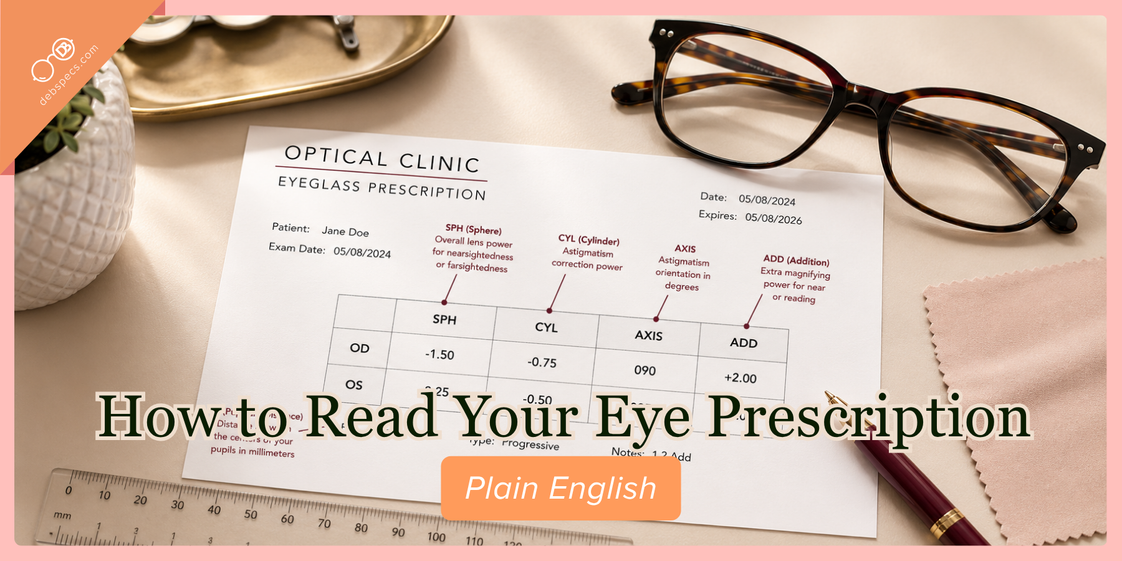
How to Read Your Eye Prescription in Plain English
Posted by Team Debby on 31st Jul 2026
TL;DR: An eye prescription is a set of instructions describing the lens correction needed by your right and left eyes. OD and OS identify each eye, SPH describes the main lens power, CYL and AXIS describe astigmatism correction, and ADD shows the extra near power used for reading.
What is an eye prescription?
An eye prescription is a written set of measurements telling an optical lab how much vision correction each eye needs and how that correction should be placed in the lenses.
It may include unfamiliar abbreviations, plus and minus signs, decimal numbers, and values measured in degrees. Each item describes a different part of the lens correction. The numbers are not a score, and they do not measure your overall eye health.
The National Eye Institute estimates that more than 150 million Americans have a refractive error. These include nearsightedness, farsightedness, astigmatism, and presbyopia.
Why should you understand an old glasses prescription?
An old prescription provides a snapshot of what your eyes needed on the day of that examination. It can help you understand whether your lenses included distance correction, astigmatism correction, reading help, or separate powers for each eye.
It can also make conversations with an optometrist or optical shop easier. You will know which numbers refer to the right eye, why one eye has a different value, and why a complete prescription cannot always be replaced by a pair of ready-made readers.
An old prescription should not automatically be treated as a current one. Your vision needs can change, and the paper does not show everything assessed during a comprehensive eye examination. It explains the lens correction that was prescribed, not whether your eyes are healthy today.
What do OD, OS, and OU mean?
Most prescriptions separate the right and left eyes because they may need different corrections.
- OD: Oculus dexter, meaning the right eye
- OS: Oculus sinister, meaning the left eye
- OU: Oculus uterque, meaning both eyes
Some modern prescriptions simply use RE for right eye and LE for left eye. OD does not mean dominant eye, and OS does not mean weaker eye. They are only labels showing which row belongs to which eye.
Debby Burk Optical's guide to OD, OS, and common ocular prescription terms provides a closer look at how the two eyes are recorded.
How do you read an eye prescription chart?
Here is a realistic example of how a glasses prescription may appear:
| Eye | SPH | CYL | AXIS | ADD |
|---|---|---|---|---|
| OD | -1.50 | -0.75 | 090 | +2.00 |
| OS | -1.25 | -0.50 | 080 | +2.00 |
In plain English, this example includes a different distance correction for each eye, some astigmatism correction, and additional near power for reading. Each column has a separate purpose, so the values should not all be added together.
What does SPH mean on an eye prescription?
SPH stands for sphere. It is the main lens power used to correct nearsightedness or farsightedness and is measured in diopters.
- A minus sign, such as -1.50, usually indicates correction for nearsightedness.
- A plus sign, such as +1.50, usually indicates correction for farsightedness.
- Plano, PL, or 0.00 means no spherical correction is required for that eye.
Prescriptions are commonly written in quarter-diopter steps, such as 0.25, 0.50, and 0.75. The farther the SPH value is from zero, the more lens power is being prescribed. This does not automatically mean the eye is unhealthy or that one person has better eyes than another.
What do CYL and AXIS mean?
CYL stands for cylinder. It shows the amount of lens power used to correct astigmatism. Astigmatism can make details appear blurred or distorted at near and far distances.
CYL may be written with a plus or minus sign, depending on the notation used by the prescriber. Two prescriptions can look different while describing equivalent corrections if one has been mathematically converted between plus-cylinder and minus-cylinder formats.
AXIS shows the orientation of the cylinder correction and is written as a number from 1 to 180 degrees. It is not another lens strength. An axis of 180 is not stronger than an axis of 90.
If no astigmatism correction is needed, the CYL and AXIS spaces may be blank, marked DS, or show 0.00. The American Academy of Ophthalmology explains that an AXIS value appears only when a cylinder correction is included.
What does ADD mean for reading glasses?
ADD means additional near power. It is the extra magnification added to the distance prescription for reading and other close-up tasks.
ADD is usually written as a plus number, such as +1.50, +2.00, or +2.50. It may be used to make bifocals, trifocals, progressives, office lenses, or dedicated prescription reading glasses.
The ADD value is not always the same as the power you should buy in an over-the-counter reader. For example, a person with a minus distance prescription may have a different final near power after the distance SPH and ADD are considered together.
CYL, AXIS, differences between the eyes, and the intended reading distance also matter. Use the calculation to understand your prescription, not to replace professional lens instructions.
For a simpler explanation of ready-made strengths such as +1.50 and +2.50, see the Debby Burk Optical Reading Glasses Strength Chart.
What do PRISM, BASE, and PD mean?
PRISM is a specialized correction used when the eyes need help working together comfortably. A prism value may be paired with a base direction:
- BU: Base up
- BD: Base down
- BI: Base in
- BO: Base out
PD stands for pupillary distance. It measures the distance between the centers of your pupils in millimeters and helps the lab align the optical centers of the lenses. PD may be written as one total measurement or two separate right and left measurements.
PD is an important fitting measurement, but it is not a lens power. It may appear on your order paperwork even when it is not printed on the prescription itself.
What can understanding your prescription help you do?
- Separate distance and reading correction: You can see whether your near help comes from an ADD value or a dedicated reading prescription.
- Recognize differences between your eyes: OD and OS may have different sphere, cylinder, or axis values.
- Understand why OTC readers may not match: Ready-made readers normally use the same spherical power in both lenses and do not correct most astigmatism.
- Ask clearer questions: You can discuss the exact value that changed instead of referring to the prescription as simply stronger or weaker.
- Review an order more carefully: You can check that right-eye and left-eye values were entered in the correct rows.
Can you tell if your eyesight is getting worse?
Comparing two prescriptions can show that the prescribed correction changed, but the comparison is not always as simple as finding the largest number.
A larger SPH value may mean more spherical correction. A change in CYL may mean the astigmatism correction changed. A different AXIS changes the orientation of that correction, not its strength.
Prescriptions written in different cylinder formats can also look very different while being optically equivalent. For that reason, avoid comparing prescriptions by adding every number or assuming that a higher axis means worse vision.
Cleveland Clinic's guide to reading an eye prescription notes that the farther a diopter value is from zero, the more correction that part of the prescription requires. Your eye care professional can explain whether a change is meaningful for you.
Can you use an old prescription to order glasses?
An old prescription can help you understand your history, but it may no longer reflect your current vision. Prescription validity and expiration rules can also differ by location and by the type of eyewear being ordered.
Consider an updated examination when your vision has changed, the prescription is no longer accepted, or you notice persistent blur, headaches, double vision, glare, distortion, or difficulty seeing in one eye.
A contact lens prescription should not be copied into an eyeglass order. Contact lenses sit directly on the eyes and require additional measurements, while eyeglass lenses sit a short distance in front of them.
Who benefits most from understanding these numbers?
- Adults receiving their first multifocal or reading prescription
- People comparing a current prescription with an older one
- Online shoppers entering prescription values into an order form
- Ready-made reader users wondering why both eyes do not feel equally clear
- Anyone preparing questions for an optometrist or optical professional
When you need the same near power throughout the full lens and your vision needs are straightforward, Custom Single Vision Reading Glasses can provide uniform magnification in a frame selected for everyday fit and style. More complex prescriptions should be ordered according to the exact instructions provided by your eye care professional.
What do people ask about eye prescriptions?
What does -1.50 mean on an eye prescription?
When -1.50 appears under SPH, it usually means 1.50 diopters of nearsighted correction for that eye. Its meaning changes if it appears under a different heading.
Is an ADD of +2.00 the same as +2.00 readers?
Not necessarily. ADD is extra near power placed on top of the distance prescription. The final reading correction may also include SPH, CYL, AXIS, and different values for each eye.
Why are CYL and AXIS blank on my prescription?
Blank CYL and AXIS fields usually mean no astigmatism correction was prescribed for that eye. The prescription may instead show DS, SPH, or 0.00.
Is 20/20 vision the same as a zero prescription?
No. A 20/20 result describes visual acuity at a testing distance. A prescription describes the lens power and other corrections used to help you see clearly.
Can I use my glasses prescription to buy contact lenses?
No. Contact lenses require a separate prescription that includes lens-specific measurements and fitting information.
Your prescription is a map, not a judgment
The numbers on an old eye prescription may look technical, but each one has a focused job. OD and OS separate the eyes. SPH gives the main correction. CYL and AXIS describe astigmatism correction. ADD provides extra help for near vision.
Understanding those pieces can make eyewear decisions feel calmer and more manageable. Keep the prescription as part of your vision history, use it to ask informed questions, and rely on an updated examination when your sight or comfort has changed.