


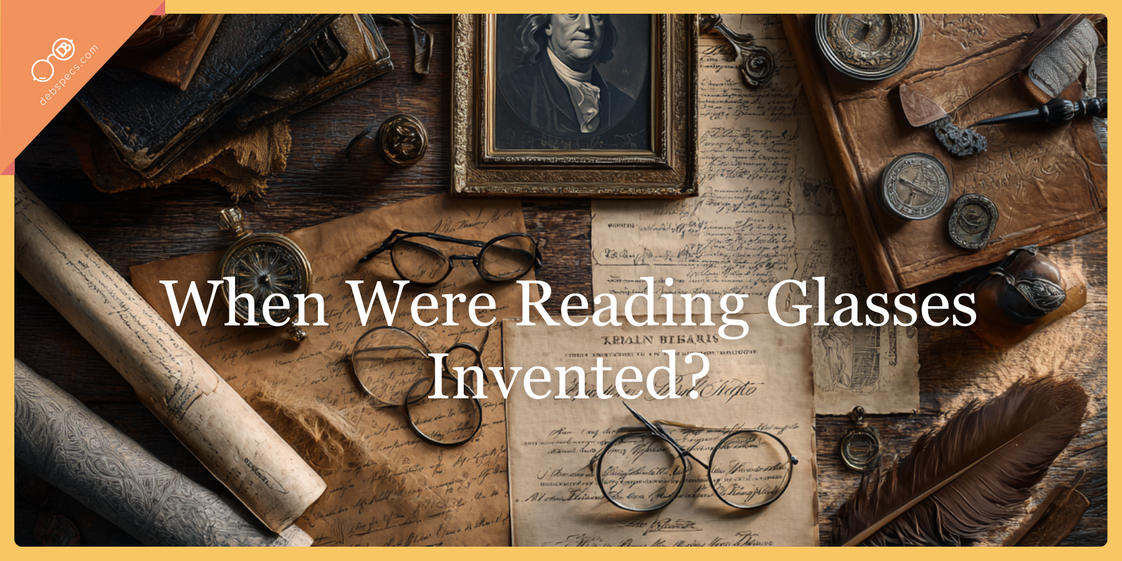
When Were Glasses Invented?
Posted by Team Debby on 14th Feb 2026
When were glasses first invented?
The earliest known eyeglasses appeared in Italy in the late 13th century, around the 1280s. These early glasses were designed to help people see up close—primarily monks, scholars, and scribes who spent long hours reading and writing.
They weren’t worn like modern glasses. Early versions were handheld or balanced on the nose, and they addressed only one problem: difficulty focusing on near objects.
From Early Lenses to Modern Clarity
Understanding how glasses evolved over centuries highlights just how far lens design has come. Today’s readers are crafted with far greater precision, balance, and comfort than the earliest magnifying aids. Applying that history to your everyday life means choosing lenses designed to support clear, steady vision for the way you read and work now.
Why were glasses invented in the first place?
As literacy spread, so did the need to read comfortably for longer periods of time. Age-related near vision loss—what we now call presbyopia—was just as common then as it is now.
Glasses weren’t about fashion or convenience. They were practical tools that allowed people to keep working, studying, and living independently.
How did glasses evolve beyond simple readers?
For centuries, glasses helped either near vision or distance vision—but not both at the same time. People who needed help seeing far away and up close often had to switch between pairs.
That inconvenience set the stage for one of the most important moments in eyewear history.
Did Benjamin Franklin invent glasses?
Contrary to popular belief, :contentReference[oaicite:0]{index=0} did not invent glasses. But he did invent something just as important: bifocals.
In the 1780s, Franklin was frustrated by constantly switching between distance glasses and reading glasses. His solution was brilliantly simple—he cut each lens in half.
He placed the distance portion in the top half of the frame and the reading portion in the bottom. With one pair of glasses, he could see clearly across the room and read comfortably up close.
Why Franklin’s idea mattered
- It eliminated constant glasses switching
- It supported real-life movement and tasks
- It acknowledged that vision needs change with age
- It laid the foundation for modern multifocal lenses
From cut lenses to modern dual-strength bifocals
Franklin’s original bifocals were functional—but far from refined. Over time, lens technology improved dramatically, allowing for smoother transitions, better alignment, and more comfortable viewing zones.
Today’s dual-strength bifocals follow the same core idea: one lens, two purposes—designed to support how people actually live, read, and move throughout the day.
Why not just switch glasses instead?
Switching glasses works—but it interrupts flow. Dual-strength lenses allow your eyes to stay engaged with the world naturally, without stopping to think about what pair you’re wearing.
That was true in Franklin’s time—and it’s even more true today.
Who benefits most from bifocals?
- People who need both near and distance clarity
- Anyone tired of juggling multiple pairs of glasses
- Adults experiencing presbyopia alongside distance correction
- Those who value simplicity and visual efficiency
FAQs
Did Benjamin Franklin invent glasses?
No. Glasses existed for hundreds of years before Franklin. He invented bifocals by combining two lens powers into one frame.
Why were early glasses only for reading?
Near vision loss was more noticeable in daily tasks like reading and writing, and early optics were best suited for magnification rather than distance correction.
Are modern bifocals hard to adjust to?
Modern dual-strength bifocals are designed for natural transitions and are far more comfortable than early designs.
A clear historical throughline
From 13th-century readers to Franklin’s cut lenses to today’s refined dual-strength bifocals, glasses have always existed for one reason: to help people see comfortably and live fully. The tools may have evolved—but the need hasn’t.