


How to Measure Pupillary Distance for Reading Glasses
Posted by Team Debby on 31st Jul 2026
TL;DR: Pupillary distance, or PD, tells an optical lab where to position the clearest part of each lens in front of your eyes. You can measure your distance PD at home with a millimeter ruler and convert it to an estimated reading PD, but professionally measured PD is the most dependable choice for prescription readers, strong lenses, bifocals, or progressives.
What is pupillary distance for reading glasses?
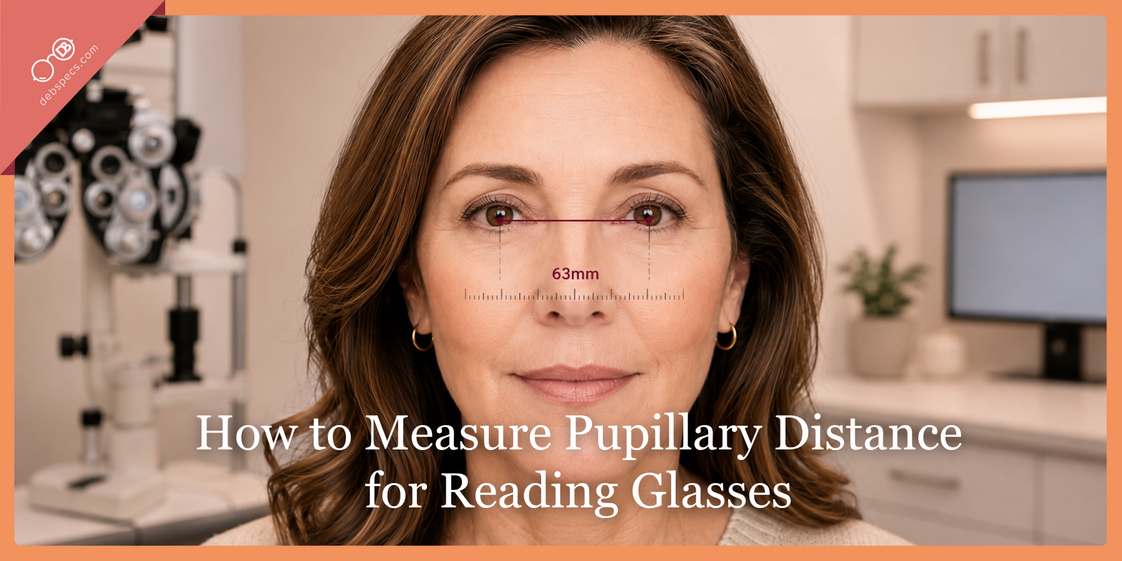
Pupillary distance is the measurement, in millimeters, between the centers of your pupils and is used to align the optical centers of your eyeglass lenses with your eyes.
You may see it written as PD on an eyeglass order form. A single PD is one number representing the full distance from one pupil to the other. A dual PD uses two numbers, one for the right eye and one for the left eye, measured from each pupil to the center of the nose.
The Cleveland Clinic explains that PD helps lens makers line up the correction in each lens with the center of your eyes. It also notes that a professional measurement is the most accurate, even though PD can be measured at home.
Why does PD matter when ordering reading glasses?
Prescription and custom reading lenses have an optical center, which is the point where the intended lens power is positioned most accurately. Your PD helps the lab place that point where your eyes naturally look through the frame.
If the optical centers sit too far inward or outward, your eyes may need to work harder to use the lenses together. According to All About Vision, an incorrect PD in prescription lenses can contribute to blurred or distorted vision, headaches, dizziness, eye strain, or double vision.
PD is different from the measurements printed inside a frame. Lens width, bridge width, and temple length describe how the glasses fit your face. PD describes where your eyes sit behind the lenses. Debby Burk Optical's guide to glasses measurements explains how those frame dimensions work alongside lens information.
What is the difference between distance PD and reading PD?
Distance PD is measured while your eyes are focused on something far away. Near PD, sometimes called reading PD, is measured while your eyes are focused on a close object.
When you look at a book or phone, your eyes turn slightly inward. This natural movement is called convergence. Because the pupils move closer together during near work, your reading PD is usually a little smaller than your distance PD.
Common estimate for near PD
Single distance PD: Subtract 3 millimeters from the total.
Example: A distance PD of 63 mm becomes an estimated near PD of 60 mm.
Dual distance PD: Subtract 1.5 millimeters from each eye's number. For example, 32/31 becomes approximately 30.5/29.5.
This is a widely used estimate described by both Warby Parker and Zenni Optical. It may not match every person or every reading distance exactly, so use the number requested by the seller rather than automatically subtracting 3 mm from every order.
How can you measure your PD at home with a ruler?
The simplest DIY approach is to measure your distance PD first, then calculate an estimated near PD only when the order form specifically asks for it.
You will need:
- A rigid ruler marked in millimeters
- A well-lit mirror
- Paper or a phone for recording the result
- A friend, when possible
Method 1: Measure with help from another person
- Remove your glasses and sit or stand with your head level.
- Look straight ahead at an object about 10 to 20 feet away. Keep both eyes open and your gaze still.
- Have your helper hold the millimeter ruler horizontally against your brow or just below your eyes.
- Align the ruler's zero mark with the center of your right pupil.
- Read the millimeter mark that lines up with the center of your left pupil.
- Repeat the measurement at least three times without changing your head position.
- Use the number that repeats consistently. If you need an estimated near PD, subtract 3 mm from the single distance PD.
Method 2: Measure by yourself in a mirror
- Stand in front of a well-lit mirror and hold the ruler flat against your brow.
- Close your right eye and use your left eye to align the zero mark with the center of your left pupil.
- Keep the ruler completely still.
- Open your right eye and close your left eye.
- Read the millimeter mark that lines up with the center of your right pupil.
- Measure several times. A result that changes with every attempt should not be used for ordering.
Measuring with another person is often easier because you can keep your head and ruler still. A digital PD tool may also be helpful, but results can vary with camera angle, lighting, screen size, and how accurately the tool is calibrated.
What are the benefits of measuring PD carefully?
- Better lens alignment: The optical center can be positioned more closely in front of each pupil.
- More comfortable near work: Proper alignment may reduce the extra effort needed to use both lenses together.
- More confident online ordering: You can provide the lab with a measurement rather than relying on a general average.
- More precise custom readers: PD helps distinguish made-to-order lenses from ready-made readers with fixed optical centers.
- A reusable reference: Adult PD usually remains stable, although your prescription and preferred reading distance may change.
Do over-the-counter reading glasses require a PD?
Most ready-made reading glasses do not ask for your PD. They are produced with the same lens power in both eyes and with optical centers set for a general range of wearers.
This convenience works well for many people who have similar vision needs in both eyes and use moderate strengths for occasional close-up tasks. However, ready-made readers cannot individually position the optical center for your exact right and left measurements.
PD becomes more important when lenses are being made specifically for you. Debby Burk Optical's Custom Single Vision Reading Glasses offer full-lens magnification for close work in frames selected for personal fit and style.
Is DIY pupillary distance accurate enough?
A careful home measurement can provide a useful result for a straightforward single-vision order, especially when repeated measurements agree. It is not as reliable as measurement with a professional pupillometer.
Avoid guessing or using an average number. Adult PD values vary, and the right and left sides of the face are not always perfectly symmetrical. Dividing a single PD exactly in half does not necessarily produce an accurate dual PD.
Have your PD measured professionally if you need strong prescription lenses, separate right and left powers, prism correction, bifocals, trifocals, progressives, or lenses for several working distances. Professional help is also appropriate if your results vary by more than a millimeter or two, or if new glasses cause persistent blur, headaches, dizziness, or double vision.
Who can use a DIY reading PD measurement?
- Adults ordering straightforward custom single-vision readers
- People whose right and left prescriptions are uncomplicated
- Online shoppers whose repeated measurements produce the same result
- Someone replacing glasses using a previously confirmed PD
- Readers whose order form clearly states whether it needs distance or near PD
PD is only one part of an eyewear order. Your prescription may also include OD, OS, sphere, cylinder, axis, or ADD values. Debby Burk Optical's guide to OD, OS, and common prescription terms explains what these abbreviations mean and how they differ from PD.
What should you check before submitting your PD?
- Does the form request distance PD or near PD?
- Does it request one number or separate right and left numbers?
- Did you measure in millimeters rather than inches?
- Did the same result appear at least three times?
- Are you entering the original distance PD rather than subtracting 3 mm twice?
When an order form simply says PD, read the seller's instructions before converting the number. Some labs ask for your distance PD and calculate the near placement themselves. Others specifically request near PD for reading glasses.
What do people ask about PD for reading glasses?
Is reading PD always 3 mm less than distance PD?
Subtracting 3 mm is a common estimate for a single PD, but it is not an exact rule for every person or reading distance. A professionally measured near PD is more precise.
Can I find my PD on my eyeglass prescription?
Sometimes. PD may be printed as one number or as two right and left measurements. It is not included on every prescription, so you may need to request it from your eye care provider or optical shop.
What is a normal PD for an adult?
Many adults have a single distance PD near the low 60s, but there is no one correct number for everyone. A value that differs from an average should not automatically be changed.
Can I use my distance PD for reading glasses?
Use the measurement requested by the optical lab. Some sellers want distance PD and make the near adjustment themselves. Others ask you to enter near PD directly.
Does PD change when my reading strength changes?
Your basic adult distance PD usually remains stable. The appropriate near placement can vary slightly with working distance, lens design, and how your eyes converge, even when the frame stays the same.
Measure carefully, then follow the order form
Pupillary distance is a small measurement with an important purpose. It helps place each lens where your eyes can use it comfortably and naturally.
A millimeter ruler, steady gaze, and several repeated measurements can give you a useful starting point. For more complex lenses or uncertain results, a professional measurement offers greater confidence. Most importantly, confirm whether your order requires distance PD or near PD before entering the number.