


The 'Juggling Glasses' Problem and How To End It
Posted by Team Debby on 26th May 2026
Tired of Switching Reading Glasses? End the Juggling Act
TL;DR
If you are tired of switching reading glasses all day, the issue is usually not that you need “more glasses.” It is that each pair is solving only one distance at a time. Bifocal, progressive, and dual-strength reading glasses can help reduce the juggling by putting more than one visual zone into a single pair.
A Simpler Way to Move Through the Day
When one pair only solves one distance, reading can start to feel more complicated than it should. These reader options are designed to support the moments when your eyes move between screens, small print, labels, and everyday tasks, helping reduce the need to keep switching from pair to pair.
What is the “juggling glasses” problem?
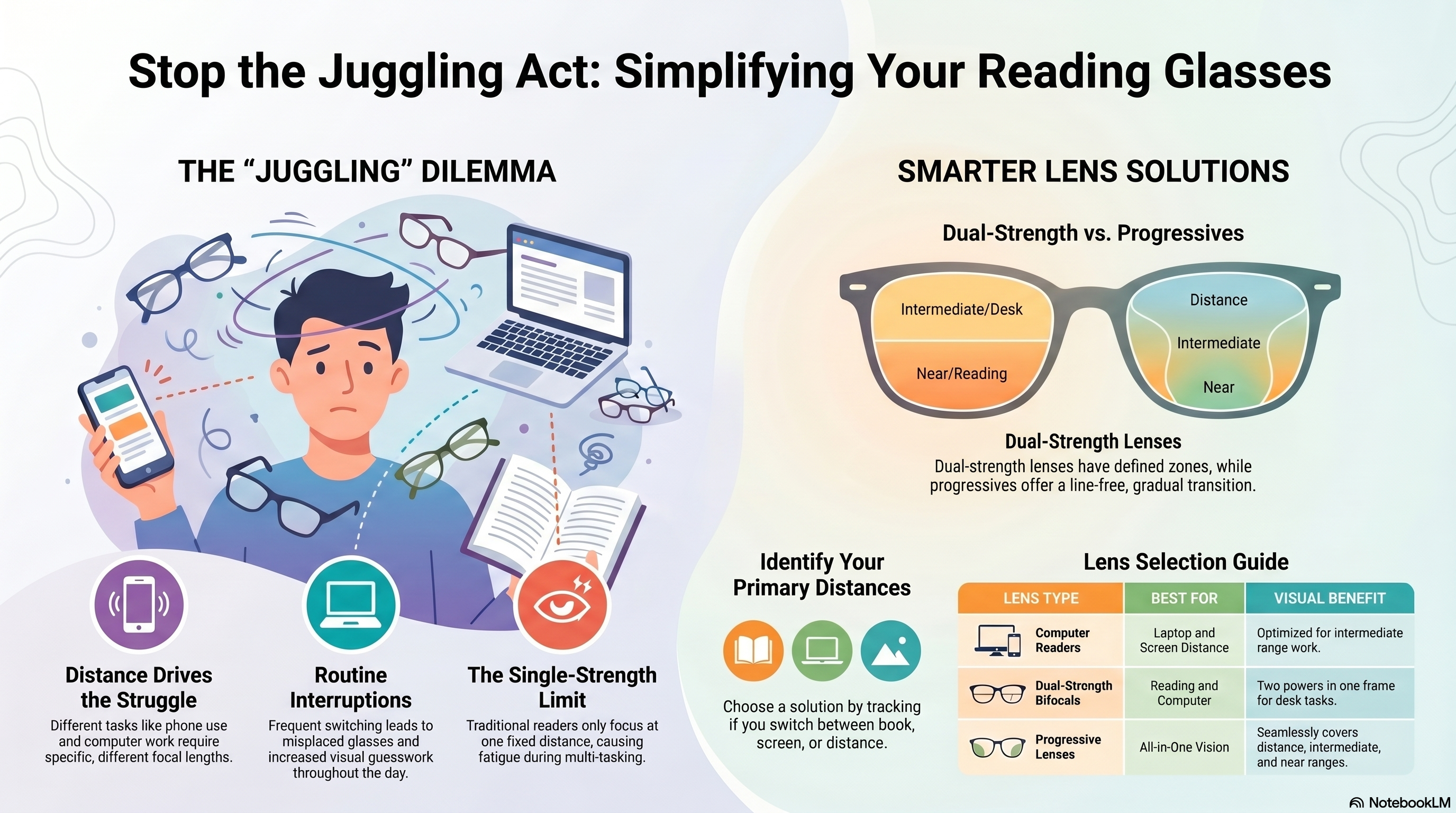
The juggling glasses problem happens when one pair of readers works for one task, but not for the rest of your day, so you keep switching between multiple pairs for reading, screens, driving, cooking, errands, or close-up work.
One pair is on your desk. One is in your purse. One lives by the bed. Another is somewhere in the car. And somehow, the exact pair you need is never the one in your hand.
This is especially common after 40, when near focus naturally changes. The National Eye Institute explains that presbyopia is a normal part of aging that makes it harder to see things up close, which is why many adults begin relying on reading glasses for everyday tasks.
Why do people end up switching reading glasses all day?
Most basic readers are made for one close-up distance. That can be perfect for a book or phone, but less helpful when your day keeps changing.
For example, your strong readers may help with tiny print on a label, but feel too intense for your laptop. Your computer glasses may feel comfortable at your desk, but not strong enough for a recipe card. Your driving glasses may help with distance, but not with the dashboard, GPS, or phone.
That is when people start collecting pairs for every room and every task. It works for a while, but it is not always convenient, stylish, or calm.
Why does this matter in real life?
Switching glasses is not just a small annoyance. It interrupts your day.
You may notice it when you are cooking and need to move between the recipe, the stove, and the countertop. Or when you are working and keep taking readers on and off to look between your computer and paperwork. Or when you are out shopping and need to read a price tag, then look across the store.
The real frustration is not the glasses themselves. It is the constant pause: find them, switch them, remove them, lose them, repeat.
How can one pair help with more than one distance?
The solution is usually a lens design with more than one viewing area. Instead of using separate glasses for separate tasks, the lens gives you different zones for different kinds of focus.
That may mean a bifocal reader, a progressive lens, or a dual-strength bifocal reader. Each option works differently, but the goal is similar: fewer interruptions and less switching throughout the day.
The American Academy of Ophthalmology explains that bifocal and trifocal lenses use separate magnification levels, while progressive lenses offer multiple powers without visible dividing lines. In simple terms, both approaches are designed to help your eyes move between tasks more easily.
What are the main alternatives to multiple reading glasses?
If you are tired of switching reading glasses, these are the most common options to consider:
- Bifocal reading glasses: These usually have a clear or distance-friendly upper area and a magnified lower area for reading.
- Dual-strength bifocal readers: These allow two reading strengths in one pair, such as a lighter top strength for computer distance and a stronger bottom strength for close reading.
- Progressive lenses: These provide a gradual shift between distance, intermediate, and near zones without a visible line.
- Task-specific readers: These are still separate pairs, but chosen more intentionally for certain activities like computer work, crafting, or music.
The best choice depends on what kind of switching bothers you most.
What are dual-strength bifocal reading glasses?
Dual-strength bifocal reading glasses are readers with one strength in the top portion of the lens and another strength in the lower reading segment.
This can be especially helpful if you do not need a fully clear top, but you do need two different levels of reading help. For example, someone may want a lighter strength on top for a computer screen and a stronger strength on the bottom for phone text, documents, or labels.
This is different from standard drugstore readers, where the entire lens is usually one power. It is also different from traditional lined bifocals with a clear top and magnified bottom. Dual-strength readers are designed for people whose day includes more than one near or intermediate distance.
What are the benefits of ending the glasses juggling act?
The right multi-zone reader can make your day feel simpler. Not perfect for every possible situation, but noticeably smoother.
- Fewer interruptions: You do not have to stop as often to find a different pair.
- More natural transitions: You can move from one task to another with less on-and-off handling.
- Less clutter: You may not need readers scattered across every room, bag, and table.
- Better task matching: Different zones can support different distances more thoughtfully.
- More confidence outside the house: One useful pair can feel easier than carrying several backups.
Are bifocals or progressives better if you want one pair for everything?
Bifocals and progressives solve the problem in different ways.
Bifocals have a more defined reading area. Many people like them because the near zone is easier to find. The tradeoff is that there is usually a visible line or a more obvious shift between zones.
Progressives offer a smoother, no-line look with multiple focus areas in one lens. They can feel very natural once you adjust, but they may take time to get used to. The Warby Parker guide to progressives vs. readers notes that progressives are designed for all-day wear with zones for distance, intermediate, and near viewing, but they usually involve an adjustment period.
If your main issue is switching between computer distance and close reading, dual-strength bifocal readers may be a more focused solution than a full progressive lens. If you also need distance correction, progressives or prescription multifocals may be worth discussing with an eye care professional.
Is it worth getting a pair that does more than regular readers?
It can be worth it if switching glasses is affecting your routine. If you only need readers for a few minutes a day, simple single-strength readers may be enough. But if you are constantly moving between screens, paperwork, phone text, labels, menus, and household tasks, one basic reader strength may feel limiting.
The value is not only in seeing clearly. It is in reducing the small daily friction that comes from changing pairs over and over.
A more thoughtful lens setup may be especially helpful if you have already tried keeping several readers nearby and still feel like you are always reaching for the wrong one.
Are there downsides to multi-zone reading glasses?
Yes, and it is helpful to know them before choosing.
Bifocals require you to learn where the reading segment sits. Progressives may require a short adjustment period. Dual-strength bifocals are most helpful when the chosen top and bottom strengths match your real working distances.
The biggest downside is choosing the wrong type for the wrong task. A beautiful solution for desk work may not be the best solution for driving. A strong close-up segment may be wonderful for small print but too strong for a computer screen. That is why the goal is not simply “one pair for everything.” The goal is one better pair for the tasks you repeat most.
Who may not need bifocal or dual-strength readers?
You may not need a multi-zone reader if your vision needs are very simple.
A standard single-strength reader may still be enough if:
- You only use readers for short close-up moments
- One strength already works comfortably for your main tasks
- You do not switch between near and intermediate distances often
- You prefer separate dedicated pairs for different activities
It is also a good idea to schedule an eye exam if your vision changes suddenly, if one eye seems much blurrier than the other, or if readers no longer help the way they used to.
Who is this best for?
A better multi-distance reader setup may be best for people who feel their day is full of visual “in-between” moments.
You may benefit if you:
- Switch between computer work and close reading
- Take readers on and off all day
- Lose glasses because you keep moving them from room to room
- Need one strength for screens and another for small print
- Want a more polished option than several drugstore pairs
- Feel frustrated by readers that only solve part of the problem
Can DebSpecs help you stop switching between readers?
Yes. DebSpecs offers reader options designed for real life, including styles that can help reduce the need to move between multiple pairs throughout the day.
If your main frustration is switching between different reading strengths, Dual Bifocal Reading Glasses may be a helpful place to start. If you are comparing lens types, the DebSpecs guide to Progressive vs Bifocal can help clarify the difference. For a broader overview, you can also explore The Complete Guide to Glasses Types.
The goal is not to pressure you into a complicated lens. It is to help you find the simplest option that fits the way your eyes actually move through the day.
FAQs about switching reading glasses
Why do I need different reading glasses for different tasks?
Different tasks happen at different distances. A strength that works beautifully for a book may be too strong for a computer screen or not strong enough for tiny print.
Can one pair of glasses really replace multiple readers?
Sometimes, yes. A bifocal, progressive, or dual-strength reader can reduce how often you switch pairs, especially if your main tasks fall into predictable near and intermediate distances.
Are dual-strength bifocal readers the same as progressives?
No. Dual-strength bifocal readers usually have two specific reading powers, while progressives gradually shift across multiple zones. They solve similar frustrations in different ways.
What if I only need readers for small print?
If you only need help with small print for short moments, a standard reader may be enough. Multi-zone readers become more useful when you switch between several close or intermediate tasks often.
A calmer way to see through your day
Being tired of switching reading glasses is a real-life problem, not a small complaint. It means your eyes are doing more than one kind of work, and your current readers may only be helping with one part of it.
With the right bifocal, progressive, or dual-strength reader setup, your glasses can feel less like something you constantly manage and more like something that quietly supports the way you already live.