


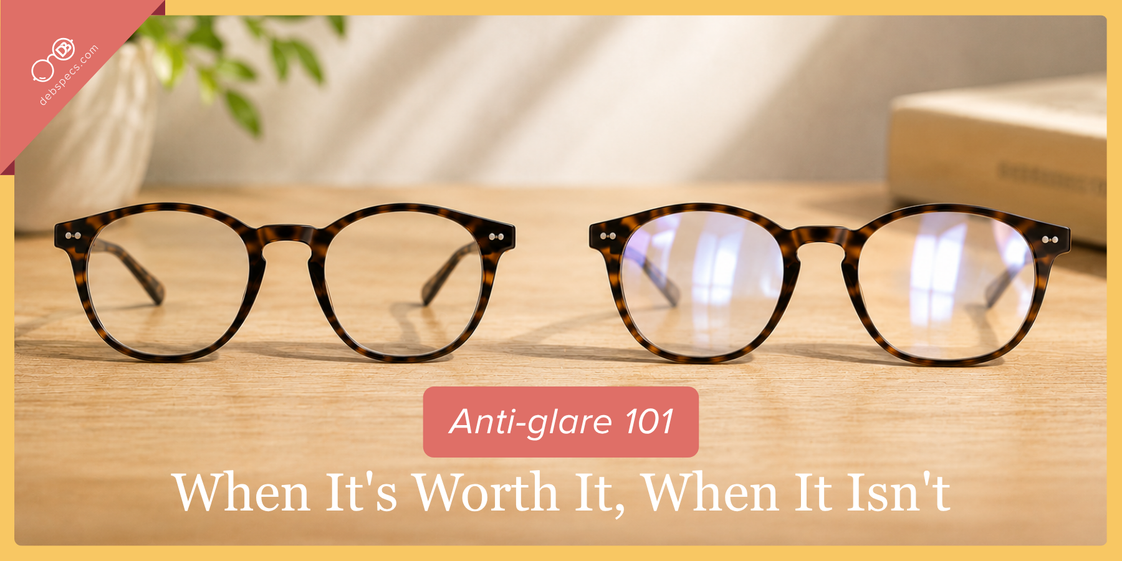
Anti-Glare 101: When It's Worth It, When It Isn't
Posted by Team Debby on 25th Jun 2026
Is Anti-Glare Coating Worth It on Reading Glasses?
TL;DR: Anti-glare coating on reading glasses can be worth it if reflections, lamps, screens, night driving, or bright indoor lighting make your lenses feel distracting. It may not be necessary if you only use simple readers for short, occasional close-up tasks.
What is anti-glare coating on reading glasses?
Anti-glare coating, also called anti-reflective or AR coating, is a thin lens treatment that reduces reflections from the front and back surfaces of your glasses.
In plain English, it helps reduce the shiny reflections you may see on your lenses when light hits them. That can include reflections from lamps, windows, phone screens, overhead lights, headlights, or bright rooms.
Anti-glare does not change your reading strength. A +2.00 reader is still a +2.00 reader. What it can change is how clean, calm, and distraction-free the lenses feel in certain lighting situations.
Choosing Lens Features That Fit Your Routine
Anti-glare coatings can make a noticeable difference for some daily activities, while other situations may not call for the extra enhancement. Understanding when they provide the greatest benefit makes it easier to choose readers designed to match how, where, and when you use them most.
Why does anti-glare matter for readers?
Reading glasses are often used in the exact places where glare shows up most: under kitchen lights, beside bedside lamps, at computer screens, in offices, in restaurants, and while checking your phone in the evening.
If your lenses catch every little light source, your eyes may feel like they are working around the reflection instead of simply reading through the lens. That does not always mean your reader strength is wrong. Sometimes the light around you is the problem.
The American Academy of Ophthalmology explains that anti-reflective coating decreases reflections from bright lights off eyeglasses. You can read their overview of the advantages of anti-reflective coating.
How does anti-glare coating work?
When light hits a lens, some of it passes through and some of it bounces off the lens surface. Anti-glare coating helps reduce that bouncing effect.
The result is a lens that looks clearer from the outside and feels less reflective from the inside. This is why glasses with anti-reflective coating often photograph better, look more transparent in conversations, and feel more comfortable under strong light.
Mayo Clinic Health System notes that anti-reflective or anti-glare coating is commonly used to reduce glare and improve vision in bright light conditions. Their guide to advances in eyewear and lens coatings gives a helpful overview.
What are the benefits of anti-glare reading glasses?
Anti-glare coating is most helpful when reflections are part of your daily routine.
- Less reflection from lamps: Helpful for reading at night, under pendant lights, or beside a bright task lamp.
- Clearer-looking lenses: Your eyes are easier to see through the glasses during conversations, photos, and video calls.
- More comfortable screen use: It may reduce distracting reflections from monitors, tablets, and phones.
- Better comfort in bright indoor spaces: Useful in offices, stores, kitchens, and rooms with overhead lighting.
- Less visual distraction while reading: When reflections are reduced, the page or screen can feel easier to focus on.
If you are comparing lens features, DebSpecs breaks this down further in The Truth About Lens Tech: Blue Light, Anti-Glare & Polarized Readers Explained.
When is anti-glare coating worth it on reading glasses?
Anti-glare coating is usually worth considering when your readers are part of your real daily life, not just a quick backup pair.
It may be worth it if you:
- Read under lamps or overhead lights often
- Use readers at a computer, tablet, or phone
- Notice reflections on your lenses in photos or video calls
- Feel bothered by bright indoor lighting
- Drive at night and use glasses to see dashboard details
- Wear your readers for long stretches instead of quick moments
Think of anti-glare as a comfort feature. It does not make the prescription stronger, but it can make your lenses feel calmer in visually busy spaces.
When is anti-glare coating not necessary?
Anti-glare is not essential for everyone. If you only use inexpensive readers for a few seconds at a time, such as checking a receipt or reading a label, you may not notice enough benefit to care about the upgrade.
The American Academy of Ophthalmology has noted that anti-reflective coating is not necessary for basic reading glasses and may not noticeably improve the functionality of simple readers. Their answer about anti-reflective coating on reading glasses is a good reminder that the value depends on how you use your glasses.
In other words, anti-glare is not a must-have for every pair. It becomes more valuable when your readers are something you rely on often, especially in reflective or bright settings.
Is anti-glare the same as blue light or polarized lenses?
No. Anti-glare, blue light, and polarized lenses solve different problems.
- Anti-glare coating: Reduces reflections on the lens surface.
- Blue light filtering: Helps filter a portion of blue-violet light from digital screens and artificial lighting.
- Polarized lenses: Reduce reflected outdoor glare from roads, water, windshields, and other shiny surfaces.
If your issue is screen reflections or lamp glare on the lenses, anti-glare is the more relevant feature. If your issue is harsh outdoor glare, polarized readers may be the better match. If your issue is long screen days, you may want to compare both anti-glare and blue light options.
For screen-heavy days, you may also find DebSpecs’ Guide to Choosing the Right Computer Glasses helpful.
What are the downsides of anti-glare coating?
The main downside is that coated lenses need gentle care. Smudges may be more noticeable on some anti-reflective lenses, and harsh cleaners can damage coatings over time.
Common concerns include:
- They may show fingerprints and oils more clearly.
- They should not be cleaned with paper towels, tissues, or household glass cleaner.
- They may add cost compared with basic readers.
- They do not replace the need for the correct reader strength.
This is why anti-glare is best for people who will care for their readers thoughtfully. A clean microfiber cloth and lens-safe cleaner go a long way.
Who benefits most from anti-glare readers?
Anti-glare readers are best for people who notice reflections enough that they interrupt comfort.
- Adults who read at night under lamps
- People who work at computers or tablets
- Anyone who joins frequent video calls
- Readers who use glasses in offices, kitchens, or bright retail spaces
- People who want lenses that look clearer and less reflective
- Anyone who wears readers for extended periods instead of quick tasks
Who may not need anti-glare coating?
You may not need anti-glare if your readers are mostly a backup pair, if you only wear them for very short close-up moments, or if reflections have never bothered you.
You may also skip it on a pair you keep in a workshop, glove compartment, junk drawer, or travel bag where durability and convenience matter more than lens refinement.
The better question is not “Is anti-glare always worth it?” The better question is “Do reflections get in the way of how I actually use my readers?”
Can DebSpecs readers include anti-glare options?
Yes. DebSpecs offers lens options designed for everyday reading comfort, including anti-reflective coating on many custom reader choices. This can be especially helpful if you want your readers to feel more polished, comfortable, and wearable for daily use.
If you are already choosing a custom pair, anti-glare may be worth considering as part of the lens setup, especially if you use your readers for screens, indoor lighting, recipes, books, or work. For more detail, see DebSpecs’ guide, Anti-Reflective Coating: Unveiling Its Purpose and Benefits.
FAQs about anti-glare coating on reading glasses
Does anti-glare coating make reading glasses stronger?
No. Anti-glare coating does not change your magnification. It helps reduce reflections on the lens surface, which may make reading feel more comfortable in certain lighting.
Is anti-glare coating good for computer reading glasses?
It can be helpful because computer use often involves reflections from screens, windows, and overhead lighting. Many people who wear readers at a desk find anti-glare more noticeable than those who only read briefly.
Is anti-glare coating the same as scratch-resistant coating?
No. Anti-glare reduces reflections. Scratch-resistant coating helps protect against minor surface scratches. Some lenses may offer both, but they are not the same feature.
Do anti-glare lenses get dirty faster?
They do not necessarily get dirty faster, but smudges can be more noticeable because the lens surface is clearer. A clean microfiber cloth and lens-safe cleaner help keep them looking their best.
Is anti-glare coating worth it for cheap readers?
Usually, it depends on how often you wear them. For a quick backup pair, it may not matter. For readers you use daily, anti-glare can make the lens experience feel more comfortable and refined.
The honest answer: anti-glare is about comfort, not pressure
Anti-glare coating is not something every reader absolutely needs. But for the right person, it can make glasses feel noticeably easier to live with.
If reflections, bright lights, screens, or video calls bother you, anti-glare is worth considering. If your readers are only for quick labels and occasional small print, a simple pair may be perfectly fine.
Good eyewear should match your real life. When your lenses feel calm, clear, and comfortable, reading becomes less about fighting the light and more about simply seeing what you came to see.