


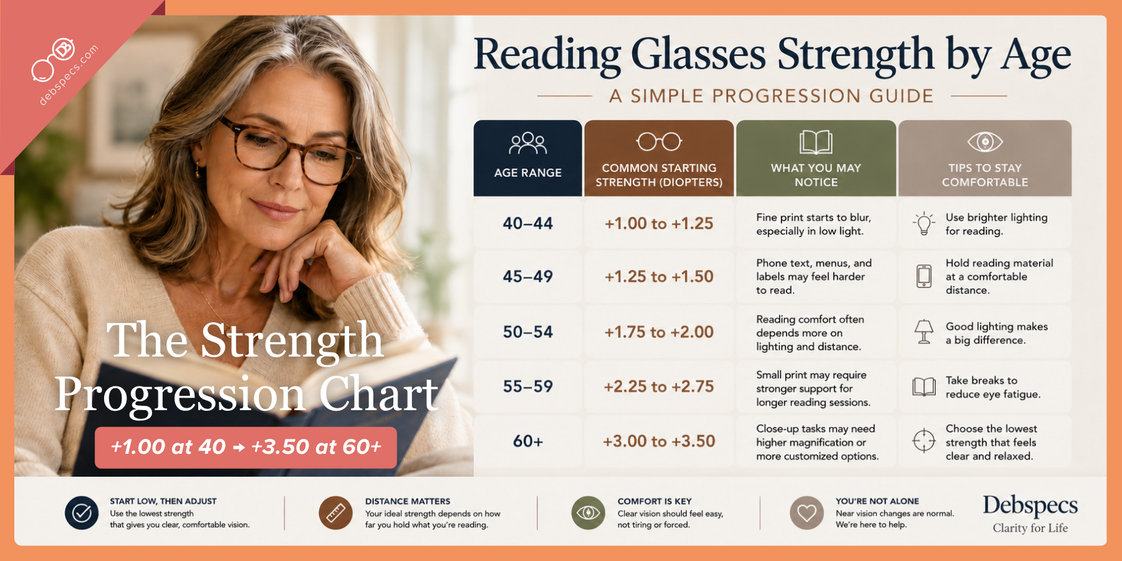
The Strength Progression Chart: +1.00 at 40 → +3.50 at 60+
Posted by Team Debby on 26th May 2026
Reading Glasses Strength by Age: A +1.00 to +3.50 Chart
TL;DR
Reading glasses strength usually starts around +1.00 in your early 40s and may gradually move toward +2.50, +3.00, or even +3.50 as near vision changes with age. An age-based chart is a helpful starting point, but the right strength also depends on your reading distance, comfort, screen habits, and whether your eyes feel relaxed while using them.
Putting Your Strength Range Into Practice
As near vision changes gradually, the most helpful reader is not always the strongest one — it is the one that matches your age, reading distance, and everyday comfort. These reader options are designed to support that next step with clearer close-up vision, better balance, and a more natural feel as your strength needs change over time.
What does reading glasses strength by age mean?
Reading glasses strength by age is a general guide that estimates which diopter power may help you see close-up text more clearly as your near vision naturally changes over time.
A diopter is the number printed on reading glasses, such as +1.00, +1.50, +2.00, or +3.50. The higher the number, the stronger the magnification.
Most people begin noticing near-vision changes in their 40s. Small print looks softer, menus need more light, and your phone may slowly move farther away from your face. The American Academy of Ophthalmology explains that after age 40, the lens inside the eye becomes more rigid, making close-up focus harder.
Why does your reading glasses strength change as you get older?
Your eyes work a little like a camera lens. When you are younger, the natural lens inside the eye can adjust easily between distance and close-up focus. As the years pass, that flexibility gradually changes.
That is why the same pair of readers that worked beautifully at 45 may feel weak by 52. It does not mean your eyes suddenly “went bad.” It often means your close-up focus needs more support than it used to.
The National Eye Institute describes presbyopia as a normal part of aging that makes it harder for middle-aged and older adults to see things up close. In everyday life, that can show up during moments like:
- Reading a menu in soft restaurant lighting
- Checking medicine labels or ingredient lists
- Looking at your phone after a long day
- Doing close work like sewing, crafts, cooking, or paperwork
- Switching between a book, tablet, laptop, and phone
What reading glasses strength do I need by age?
The chart below gives a practical starting point for common reading glasses strengths by age. It is not a prescription, but it can help you understand the usual progression from +1.00 to +3.50.
| Age Range | Typical Reading Strength | What It May Feel Like |
|---|---|---|
| 40 to 44 | +1.00 to +1.25 | Small print is starting to blur, especially in dim light. |
| 45 to 49 | +1.25 to +1.75 | You may hold books, labels, or your phone farther away. |
| 50 to 54 | +1.75 to +2.25 | Reading is clearer with help, but weaker readers may feel tiring. |
| 55 to 59 | +2.25 to +2.75 | Fine print, recipes, and close tasks may need stronger magnification. |
| 60 to 64 | +2.50 to +3.00 | You may prefer stronger readers for close reading and detailed work. |
| 65+ | +3.00 to +3.50 | Very small print may be easier with higher-power readers and good lighting. |
This chart is best used for normal reading distance, usually around 14 to 16 inches from your eyes. If you read farther away, such as on a computer screen, you may need a lower strength than you use for a book or phone.
How do reading glasses strengths actually work?
Reading glasses do one simple thing: they help your eyes focus on close-up objects with less effort.
A +1.00 reader gives light magnification. A +2.50 reader gives stronger magnification. A +3.50 reader is stronger still and is usually used when small print or very close work needs more support.
The goal is not to choose the strongest pair you can tolerate. The goal is to choose the lowest strength that makes your reading clear and comfortable at the distance where you actually use them.
Simple rule: If the strength is right, print should look clear without you leaning in, stretching your arms out, squinting, or feeling pulled into the page.
What are the benefits of using an age-based reading glasses chart?
A reading glasses age chart is helpful because it gives you a calm, practical place to begin. Instead of guessing from a wall of strengths, you can narrow your choices before testing what feels best.
- It gives you a realistic starting range. If you are 48, you may know to compare +1.50 and +1.75 instead of jumping straight to +3.00.
- It helps explain normal progression. Moving from +1.50 to +2.00 over time is common and usually not a reason to panic.
- It reduces overbuying. You are less likely to buy several random pairs that never feel quite right.
- It supports better comfort. The right range can help reduce squinting, leaning, and unnecessary eye fatigue.
- It helps match glasses to real life. You can choose one strength for close reading and a different option for computer distance if needed.
Is a reading glasses strength chart accurate enough?
A chart is useful, but it is not perfect for everyone. Your age is only one part of the decision.
Two people can both be 55 and need different reader strengths because they read at different distances, use different lighting, spend different amounts of time on screens, or have different vision needs in each eye.
A strength chart is best for estimating simple reading magnification. It may not address astigmatism, distance vision, eye health changes, or differences between the right and left eye. If readers never feel comfortable, or if one eye seems much blurrier than the other, an eye exam is the better next step.
The Mayo Clinic notes that presbyopia symptoms can include blurred vision at normal reading distance, eyestrain, headaches after close work, and the tendency to hold reading material farther away.
Should you choose stronger reading glasses as you age?
Usually, yes, but gradually. Many people start with +1.00 or +1.25 in their 40s, then move up in small steps as reading becomes less comfortable.
The common mistake is choosing a strength that is too strong because it makes one tiny line of print look sharp for a moment. Stronger is not always better. A pair that is too strong may force you to hold reading material too close, make the page feel distorted, or feel uncomfortable after several minutes.
The best strength should feel easy, not dramatic.
How does reading distance change the strength you need?
Reading distance matters more than many people realize. Readers are usually chosen for close work, but not all close work happens at the same distance.
- Books and phones: Often held around 14 to 16 inches away, so they may need your normal reading strength.
- Computer screens: Usually farther away, so many people need less power than they use for reading.
- Crafts and detailed work: Often closer to the face, so a slightly stronger reader may feel useful.
- Cooking or music: Recipe cards, sheet music, and counters may sit at an intermediate distance, so full-strength close readers can sometimes feel too strong.
This is one reason many adults end up with more than one pair. A strength that feels perfect for a book may not feel right for a laptop.
Are there downsides to using the wrong reading glasses strength?
The wrong strength usually does not feel subtle for long. It may seem fine for a quick label, then become frustrating during real use.
Signs your readers may be too weak include:
- You still squint while reading
- You need brighter light than usual
- You hold text farther away to make it clear
- Small print looks gray, soft, or tiring
Signs your readers may be too strong include:
- You must hold text very close to your face
- The page feels too enlarged or distorted
- You feel eye strain after a short time
- Looking up from the page feels uncomfortable
How do age charts compare to printable diopter tests?
An age chart gives you an estimate. A printable diopter test helps you compare actual print clarity at a set distance. Used together, they can be very helpful.
Start with the age range that fits you, then test the nearby strengths. For example, if you are in your early 50s, you might compare +1.75, +2.00, and +2.25. Choose the one that feels clear and relaxed, not just the one that makes the print look largest.
If you are between two strengths, many people do better starting with the lower option for everyday reading, especially if the stronger pair feels intense or forces the page too close.
Who is an age-based reading glasses chart best for?
This kind of chart is especially helpful if you:
- Are buying your first pair of readers
- Have noticed your current pair no longer feels strong enough
- Want to compare +1.50, +2.00, +2.50, or +3.00 more confidently
- Use over-the-counter readers for simple close-up tasks
- Want a practical guide before choosing a new pair online
It may not be enough if you have blurry distance vision, a known prescription, astigmatism, eye disease, double vision, sudden vision changes, or frequent headaches. In those situations, it is best to check with an eye care professional.
Can DebSpecs help if you are between reader strengths?
Yes. If you are between strengths, the most helpful approach is to think about where you use your readers most.
For simple close reading, you may prefer the strength that makes books, labels, and phone text feel easy. For mixed-distance tasks, such as looking from a computer to paperwork, a slightly lower power may feel more natural. For people tired of switching glasses throughout the day, custom reader options or bifocal reader styles may make daily use feel smoother.
You can also explore these related DebSpecs guides for more help:
FAQs about reading glasses strength by age
What diopter do most people need at age 40?
Many people in their early 40s start around +1.00 to +1.25. Some may need slightly less or more depending on reading distance, lighting, and comfort.
What strength reading glasses do most people need at age 50?
Around age 50, many people fall somewhere near +1.75 to +2.25 for close reading. If your current readers feel weak, compare the next small step up rather than jumping too high.
Is +3.50 a strong reading glasses strength?
Yes. +3.50 is considered a stronger reader strength and is often used for very small print, close detail work, or later-stage presbyopia. It should still feel comfortable at your normal reading distance.
Should I buy the stronger pair if I am between two strengths?
Not always. If the stronger pair makes you hold text too close or feels intense, the lower strength may be better for everyday comfort. The right pair should feel clear and easy, not forced.
How often should reading glasses strength change?
Many people notice changes every few years from their 40s into their 60s. If your readers suddenly stop working well, or if your vision changes quickly, schedule an eye exam to make sure nothing else is affecting your sight.
The calm way to choose your next reader strength
Reading glasses strength usually changes slowly, and an age-based chart can make that process feel much less confusing. Start with the range that fits your age, pay attention to your real reading distance, and choose the strength that feels clear, relaxed, and comfortable.
The best readers are not just the strongest ones. They are the ones that help you move through your day with less squinting, less guessing, and more confidence in the small details right in front of you.