Blog

Blog

Dual Bifocal Reading Glasses: The Complete Guide to Multi-Distance Clarity

Dual Bifocal Reading Glasses: The Complete Guide to Multi-Distance Clarity

Posted by Team Debby on 29th Mar 2025

TL;DR: If you’re constantly swapping between readers, computer glasses, and distance glasses, it’s time to simplify. Our dual-strength lenses combine multiple vision powers into one pair of reading glasses — so you can read, work, and drive with clarity and style. This guide breaks down bifocals, trifocals, progressives, and our specialty option to help you find your perfect match. (Bifocal, Trifocal, Progressive, and the exclusive Dual-Strength Bifocal from debpspecs)

Why One Pair of Glasses Isn’t Enough Anymore

If you’ve ever juggled multiple pairs of glasses throughout the day, you’ve experienced presbyopia — the natural, age-related loss of near focus that begins in your 40s.

Constantly switching glasses is annoying (and easy to misplace). Multifocal lenses solve that frustration by blending multiple prescriptions into one lens — giving you clear vision at near, mid, and far distances without the eyewear shuffle.

Let’s decode your options — and help you choose the perfect balance of clarity, comfort, and confidence.

Understanding Monofocal vs. Multifocal Lenses

Monofocal Lenses: One Power, One Purpose

Monofocal lenses correct a single distance — either near, intermediate, or far.

  • Example: Reading glasses for close work or driving glasses for distance.

  • Pros: Affordable and simple.

  • Cons: You’ll need multiple pairs to handle all your visual tasks.

Multifocal Lenses: One Lens, Many Distances

Multifocal lenses combine two or more prescriptions into one frame, allowing your eyes to adjust naturally between near, mid, and far distances.

They come in three main styles — bifocals, trifocals, and progressives — plus specialized versions for certain professions or visual needs.

Curious about lens coatings and glare control? Read more about lens types or shop our dual bifocal readers.

Bifocals: The Classic Dual-Focus Solution

How They Work

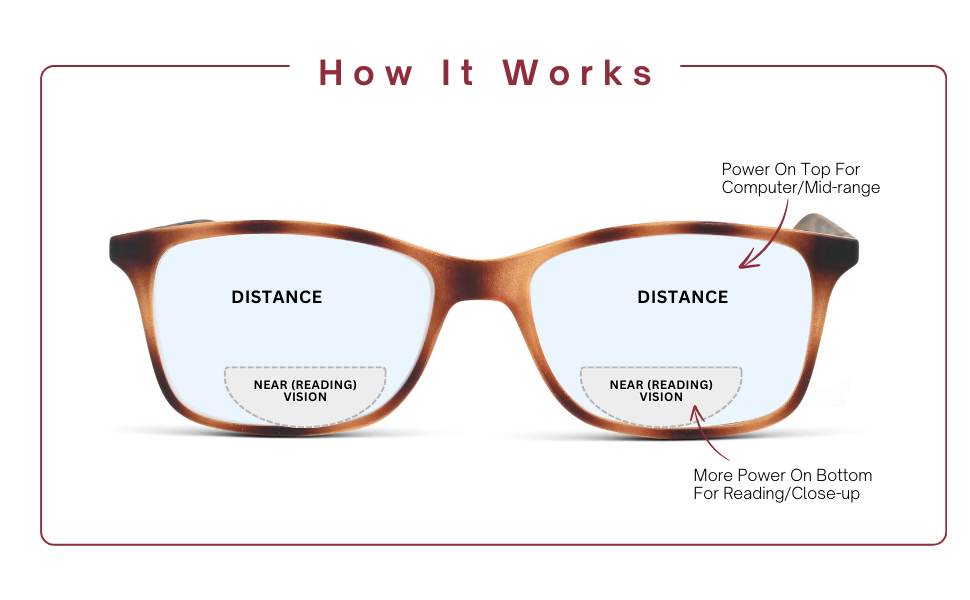
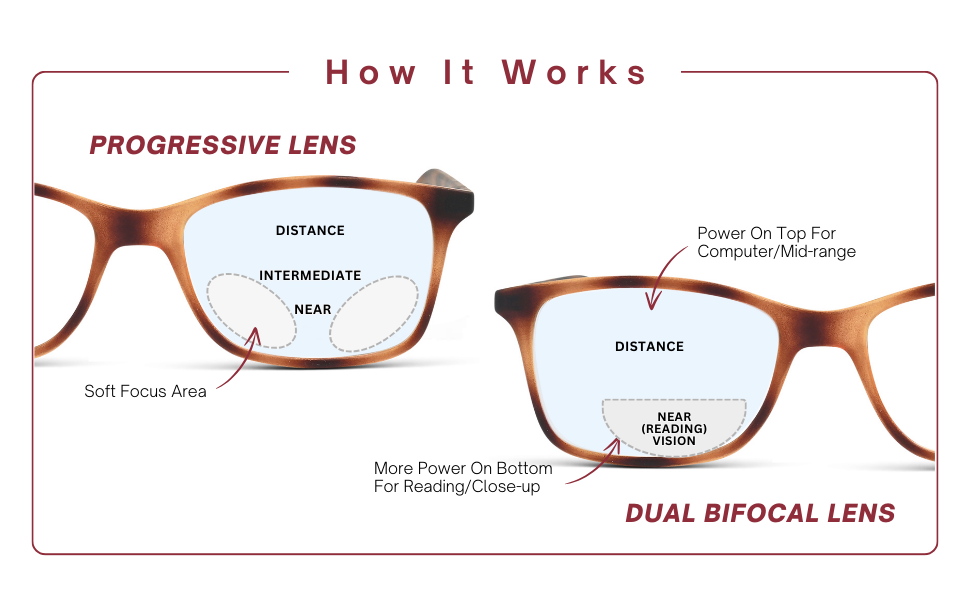
Bifocals contain often contain two distinct zones, divided by a visible line:

  • Top portion:  distance vision (driving, watching TV) - no power

  • Bottom segment: near vision (reading, texting, crafting) - power for reading

As you glance downward, you naturally switch to the close-up zone.

Pros & Cons

Pros:

  • Budget-friendly

  • Easy to adapt

  • Great for simple distance-plus-reading needs

Cons:

  • No correction for mid-range (computer) distance

  • Visible line and “image jump” when your gaze crosses the segment

Special Case: Dual (Double-D) Bifocals

What Are Dual Bifocal Readers?

Dual bifocal reading glasses feature two magnification strengths in one lens—one for close-up reading and one for mid-range tasks like computer work. Unlike traditional bifocals that only cover near and far vision, DebSpecs dual bifocals are designed for the way you actually live: reading, working on screens, and moving through daily life without juggling multiple pairs.

These are perfect for professionals who work above eye level — mechanics, electricians, librarians, artists because they prevent neck strain and awkward tilting when viewing overhead tasks

How Do They Work?

Each lens in our Dual Power Bifocal Collection has two distinct zones:

  • Upper portion: intermediate tasks (computer, across-the-room view)

  • Lower portion: close-up focus (books, phone, sewing)

This design makes shifting between tasks effortless. A simple tilt of the head brings your world into focus—no swapping glasses, no extra hassle. Two powers, one pair, endless possibilities. 

Are Dual Bifocal Glasses Right for You?

You might love them if you:

  • Often switch pairs of reading glasses to see different distances

  • Spend time on screens and with books

  •  Need clear vision for both close-up and mid-range tasks

  • Want a single, stylish solution instead of multiple pairs

Benefits of DebSpecs Dual Bifocals

  • Two strengths in each lens for seamless clarity

  • Replace both readers and computer glasses with one pair

  • Great for multitasking—reading, working, and beyond

  • Reduce eye strain from constant refocusing

  • Frames designed to flatter every face shape and size

Why Choose DebSpecs?

We’re not just making reading glasses—we’re redefining them. With DebSpecs dual bifocals, you get:

  • Precision optics designed with expert input

  • Fashion-forward styles curated for all face shapes

  • Sizes for everyone, from petite to extra wide

  • All-day comfort with premium-quality frames
  • 10+ unique frame styles tailored to bifocal lenses

  • Four fit options: Narrow, Average, Wide, and X-Wide

  • Silhouettes for every vibe: classic, bold, minimal, or trend-forward

Trifocals: Bridging the Mid-Distance Gap

How They Work

Trifocals add a third power — an intermediate zone — for arm’s-length clarity (computer screens, dashboards).
You’ll see:

  • Top: distance

  • Middle: intermediate

  • Bottom: near

Pros & Cons

Pros:

  • All three viewing distances covered

  • Ideal for heavy screen use

Cons:

  • Two visible lines

  • Slight “double jump” as you shift focus between zones

  • More adaptation required than bifocals

Best For: Professionals or hobbyists who frequently switch between computer and reading tasks.

Progressives (PALs): The Seamless Modern Solution

How They Work

Progressive lenses — often called “no-line bifocals” — provide a gradual power shift from top to bottom:

  • Top: distance

  • Middle: intermediate

  • Bottom: near

No harsh jumps, no visible lines — just smooth, natural focus across all distances.

Benefits

  • Youthful appearance: No visible segments

  • Natural transitions: Effortless focus at any distance

  • All-in-one convenience: One pair for every task

Trade-Offs

  • Peripheral distortion can cause a mild “swim effect”

  • Narrower vertical viewing channels

  • Short adjustment period (usually 3–14 days)

Pro Tip: Move your head, not just your eyes. Point your nose at what you want to see for the sharpest clarity.

Multifocal Lens Comparison Chart

Feature

Bifocal

Trifocal

Progressive (PAL)

Number of Powers

2 (Distance + Near)

3 (Distance + Intermediate + Near)

Continuous gradient

Visible Lines

Yes (1 line)

Yes (2 lines)

No

Intermediate Vision

No

Yes

Yes

Image Jump

Yes

Yes (2 transitions)

No

Peripheral Distortion

None

None

Slight “swim” effect

Adaptation Time

Short

Moderate

1–2 weeks

Best For

Simple, affordable clarity

Balanced all-distance vision

Seamless, stylish, all-in-one vision

Choosing the Right Lens: A Lifestyle Checklist

Ask yourself:

  1. How do you spend your day?

  2. Do you work above eye level?

  3. Are you sensitive to motion or distortion?

    • Yes → Avoid progressives; try bifocals or trifocals instead.

  4. Is appearance a priority?

    • Want a clean, modern look → Progressives

? Explore bifocal and progressive readers to find your perfect match.

Why a Professional Fitting Matters

Even the perfect lens design won’t help if it’s not aligned correctly.
An optometrist or optician will:

A professional fitting ensures every vision zone lines up naturally with your gaze — reducing strain and maximizing comfort.

Conclusion: Clarity at Every Distance

Modern multifocal lenses mean you never have to choose between style and function again. Whether you need the simplicity of bifocals, the versatility of trifocals, or the seamless comfort of progressives, there’s a solution tailored to your lifestyle.

Your next step?
Schedule an eye exam, discuss your daily activities with your optometrist, and invest in lenses that keep your vision as dynamic as you are.

Shop dual bifocal readers or progressive-style lenses designed for real life — and real style.

FAQ: Multifocal Lens Basics

Q: How are dual bifocals different from traditional bifocals?
A: Traditional bifocals focus on near and far distances. Dual bifocals are designed for near and intermediate vision—perfect for reading and computer work.

Q: Will people notice the bifocal line?
A: Not at all. Our dual bifocals have a subtle, seamless look that blends with stylish frames.

Q: Can I use them all day?
A: Yes! They’re made for everyday wear, from morning emails to evening novels.

Q: Do they come in my size?
A: Absolutely. We offer narrow to X-wide fits, so there’s a frame that feels made for you.

Q: Are bifocals outdated?
No — they’re still practical for people who mainly need distance and reading correction without caring about intermediate vision.

Q: How long does it take to adjust to progressive lenses?
Most people adapt within 3–14 days. If discomfort persists, your optician can fine-tune the fit.

Q: Do progressives cause dizziness?
Some experience mild “swim effect” at first. Proper fitting minimizes it.

Q: Can I use progressive lenses as computer glasses?
They work for screens, but if you’re at a computer all day, consider specialized mid-range readers.

Q: Do multifocals work for everyone?
Nearly — but extreme prescriptions or high astigmatism may require customized designs.