


What Do the Numbers Inside Your Reading Glasses Mean?
Posted by Team Debby on 31st Jul 2026
TL;DR: A number such as 52-18-140 usually describes the size of the frame, while a number such as +2.00 identifies the strength of the reading lenses. Knowing which number means what can help you replace a comfortable pair without confusing frame measurements with lens power.
What do the numbers inside reading glasses mean?
The numbers inside reading glasses usually identify the frame's lens width, bridge width, and temple length, while a separate plus number identifies the reading strength.
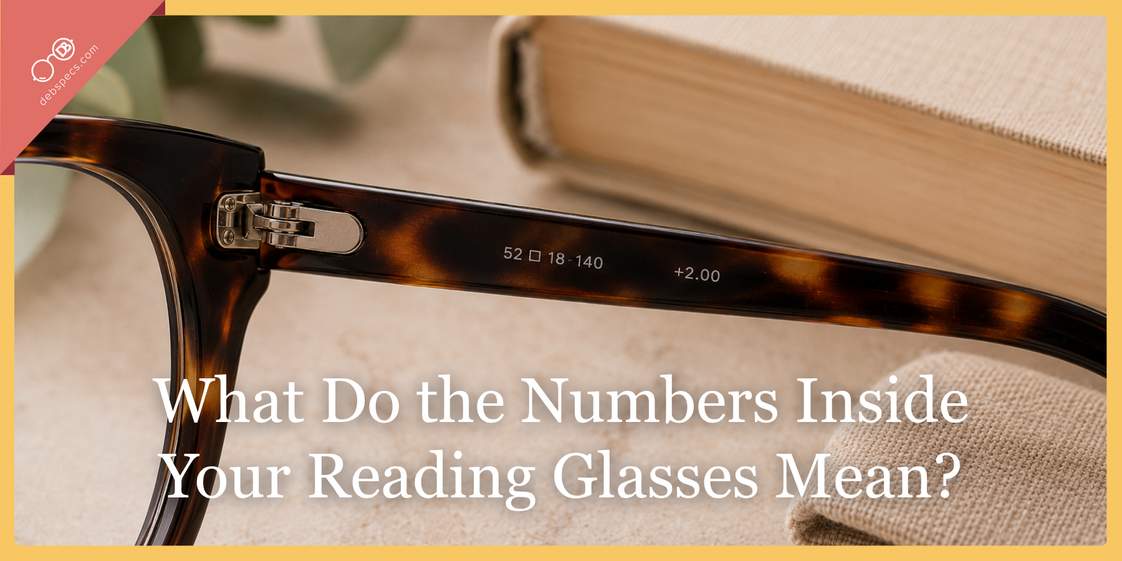
For example, you may see 52 □ 18 140 printed inside one arm. These are frame measurements in millimeters. You may also see +2.00 on the other arm, on a small sticker, or on the product packaging. That number refers to the power of the reading lenses.
Other letters and numbers may identify the frame model, color, manufacturer, or production information. They help describe the product, but they do not necessarily tell you how strongly the lenses correct your near vision. Zenni Optical's frame-number guide explains that style numbers and color codes are often printed alongside frame dimensions.
Why should you understand the numbers on your glasses?
Those tiny markings can save you from guessing when it is time to replace a scratched, loose, or misplaced pair. If your current readers fit comfortably, their measurements provide a useful starting point for finding another frame with similar proportions.
The numbers also help prevent one of the most common shopping mistakes: assuming that every printed number refers to magnification. A frame marked 52-18-140 is not a +52 reader. It is simply describing three parts of the frame.
Understanding the difference matters because lens power and frame fit solve two separate problems. The correct strength helps bring close-up text into focus. The correct measurements help the glasses sit comfortably on your nose, temples, and ears.
How do you read a number such as 52-18-140?
The three measurements normally appear in the same order: lens width, bridge width, and temple length. Warby Parker's eyeglass measurement guide confirms that these dimensions are measured in millimeters and are commonly printed inside a temple arm.
52: Lens width
The first number is the horizontal width of one lens at its widest point. In this example, each lens is 52 millimeters wide. A larger number usually means a wider lens opening, but lens shape also affects how large the frame looks and feels.
18: Bridge width
The second number measures the space between the lenses. This is the part of the frame that rests across your nose. A bridge that is too wide may slide, while one that is too narrow may pinch or sit too high.
140: Temple length
The third number is the length of the arm from the hinge to its end, including the portion that curves behind your ear. Temples that are too short may feel tight, while very long temples may not hold the frame securely.
For a closer look at how these dimensions affect comfort, visit Debby Burk Optical's guide to glasses measurements and frame fit.
What does a number such as +1.50 or +2.00 mean?
A plus number identifies the optical power of ready-made reading glasses. The power is measured in diopters, so +2.00 means the lenses have a power of two diopters. It does not mean that the lenses make everything exactly two times larger.
Higher plus numbers provide stronger close-up focusing help and generally create a closer working distance. The right number is the lowest strength that lets you read comfortably at your normal distance without unnecessary strain.
Ready-made readers typically use the same power in both lenses. Cleveland Clinic notes that the strength may appear on a sticker, the packaging, or inside the temple arm, commonly in powers from +1.00 to +4.00. Its guide to over-the-counter readers also explains why prescription glasses may be more appropriate when the eyes need different corrections.
Debby Burk Optical's reading glasses strength chart explains common diopter levels and how strength relates to everyday reading distance.
What are the benefits of knowing your frame numbers?
- Easier replacement: You can compare new frames with a pair that already feels comfortable.
- Fewer fit surprises: The measurements provide more information than labels such as small, medium, or large.
- Clearer strength choices: You are less likely to mistake frame size for reading power.
- Better online comparisons: You can review actual dimensions rather than relying only on product photographs.
- More confident gifting: Measurements and strength from a well-loved pair can help guide a thoughtful replacement.
Are frame numbers the same as an eyeglass prescription?
No. Frame measurements describe the physical size of the glasses. A prescription describes the correction each eye requires.
A complete eyeglass prescription may include OD and OS for the right and left eyes, along with terms such as SPH, CYL, AXIS, ADD, and prism. These values cannot be determined from 52-18-140 or from a model number printed inside the frame.
Debby Burk Optical's guide to OD, OS, and common prescription terms explains how right-eye and left-eye corrections are recorded separately.
Do matching numbers guarantee the same fit?
Not always. Two frames marked 52-18-140 may still feel different because of their shape, total frame width, lens height, hinge design, nose placement, material, and temple flexibility.
The printed measurements are best used as a comparison tool, not a perfect fitting formula. Staying close to the measurements of a comfortable pair can narrow the choices, but how the frame sits on your face still matters.
It is also normal for some markings to wear away over time. When that happens, you can measure the lens, bridge, and temples manually in millimeters or compare the frame with product dimensions listed online.
Who should pay close attention to these numbers?
- Anyone replacing a favorite pair of readers
- People who frequently find standard frames too narrow or too wide
- Online shoppers comparing several frame styles
- Adults buying a backup pair for another room or bag
- Someone choosing readers as a gift
When shopping, begin with the full set of clues: the frame measurements, your known reading strength, the shape of the frame, and how your current pair feels after more than a few minutes. Numbers are helpful, but comfort remains the final test.
What else do people ask about the numbers on glasses?
Do bigger numbers mean stronger reading glasses?
Only when you are looking at the plus strength. +2.50 is stronger than +1.50. A lens width of 54 millimeters is simply wider than one measuring 50 millimeters.
What does the small square between the numbers mean?
The square separates the lens width from the bridge width. A marking such as 52 □ 18 has the same basic meaning as 52-18.
Where is the reading strength printed?
It may appear inside either temple arm, on a removable lens sticker, on the case, or on the original packaging. Look for a plus sign followed by a number such as +1.50 or +2.25.
Can I order prescription glasses using the numbers inside my frames?
The frame numbers can help you choose a size, but they cannot replace a current prescription. Prescription lenses require the correction values supplied by an eye care professional.
A few small numbers can make choosing readers easier
The markings inside your reading glasses are less mysterious once you separate them into two groups. Numbers such as 52-18-140 describe the frame. Numbers such as +2.00 describe the lens strength.
Keep a note or photograph of both sets of numbers from a pair that works well. The next time you need readers, you will have a clearer starting point for finding the right strength, a familiar fit, and a frame you can wear comfortably.