


How Many Pairs of Reading Glasses Do You Really Need?
Posted by Team Debby on 31st Jul 2026
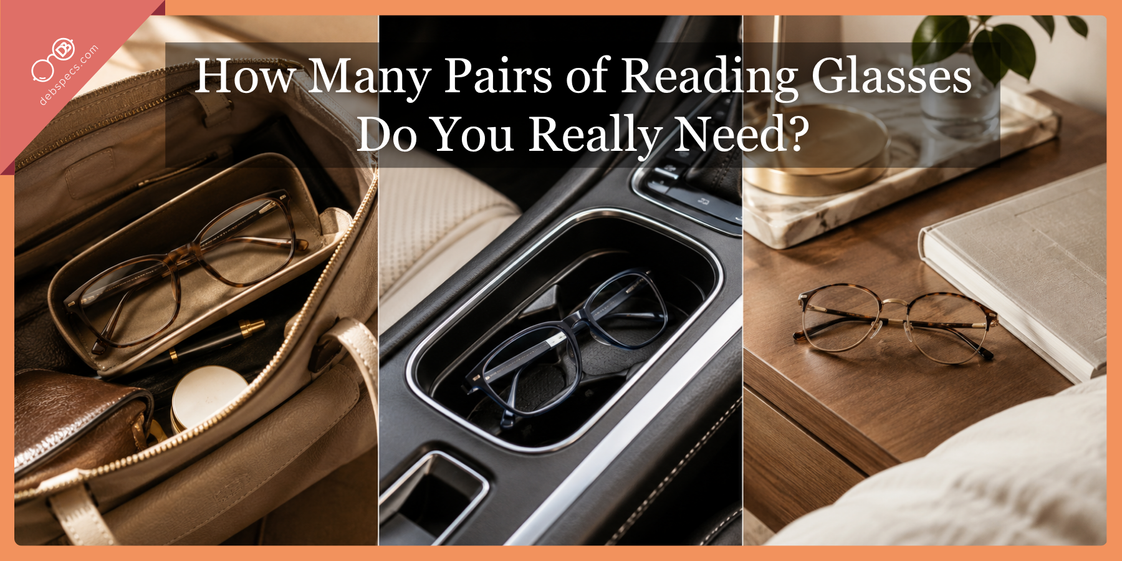
TL;DR: Three pairs of reading glasses are enough for many people: one in your purse or everyday bag, one for parked moments in the car, and one beside the bed. The goal is not to collect readers. It is to keep a dependable pair in the three places where you are most likely to need one.
What is the 3-pair reading glasses rule?
The 3-pair reading glasses rule is a simple system of keeping one pair in your everyday bag, one accessible for errands and parked car moments, and one at your bedside.
Instead of carrying a single pair from room to room, each pair has a permanent home. This makes your readers easier to find and less likely to disappear beneath a book, inside a kitchen drawer, or at the bottom of yesterday’s handbag.
Reading glasses commonly become part of daily life as presbyopia develops. The American Academy of Ophthalmology describes presbyopia as the gradual loss of the ability to see clearly up close, which is a normal part of aging.
Why does having three pairs make everyday life easier?
One pair sounds perfectly reasonable until you begin using readers several times a day. You may need them to check a text message before breakfast, read a receipt while running errands, examine a medication label, and enjoy a book before going to sleep.
When one pair follows you through every part of that routine, it can be left almost anywhere. The problem is not always forgetfulness. It is that the glasses never had a dependable place to return to.
Presbyopia often becomes noticeable after age 40, according to the Mayo Clinic. As close-up tasks become more frequent, readers can start feeling less like an occasional accessory and more like an everyday tool.
Three thoughtfully placed pairs remove dozens of small interruptions. You no longer have to search the house before reading a label or carry your bedside pair into the car and forget to bring it back.
How does the purse, car, and bedside system work?
Give each pair a clear purpose and return it to the same place after every use. The routine is what makes the system effective.
Pair 1: Your purse or everyday bag
This is your mobile pair for menus, price tags, forms, appointment cards, receipts, phone screens, and small print while you are away from home. Keep it in a slim protective case and assign it a specific pocket so it does not become buried beneath everything else.
Pair 2: Your car or errand pair
Use this pair only when the vehicle is safely parked. It can help with parking instructions, receipts, printed directions, medication labels, restaurant menus, and other close-up details during errands.
Store the glasses in a protective case rather than leaving them loose on a seat or dashboard. During very hot weather, take them with you instead of leaving them inside a heated vehicle. Standard reading glasses blur distance vision and should not be worn while driving.
Pair 3: Your bedside pair
This pair stays on the nightstand for books, devotional reading, phone messages, medication instructions, and evening routines. A small tray or stand keeps the lenses away from hard surfaces and makes the glasses easy to find in low light.
If your routine includes several work areas, hobbies, or rooms, you may eventually prefer a larger system. DebSpecs’ 4-pair reading glasses stash adds a dedicated pair for places such as the kitchen, desk, craft room, or workshop.
What are the benefits of owning multiple pairs of readers?
- Less searching: Each pair has a predictable home, so you spend less time checking counters, pockets, and cushions.
- A dependable backup: A broken or misplaced pair does not leave you without close-up help.
- Less unnecessary handling: Readers are less likely to be tossed between bags, rooms, and unprotected surfaces.
- Better task matching: You can choose a comfortable book-reading pair for the bedside and a lighter, portable frame for your bag.
- A calmer routine: Reading a menu, message, or label becomes a normal part of the moment rather than a search mission.
Is buying three pairs worth it, and are there any downsides?
Three pairs are usually worth considering when you use readers throughout the day or regularly leave your only pair in the wrong place. The value comes from convenience and backup, not simply from owning more frames.
The main downsides are added cost, possible clutter, and the chance of mixing up different strengths. You can prevent confusion by giving each pair a case, choosing clearly different frame colors, or adding a small strength label inside each case.
The three pairs do not necessarily need identical lenses. Your bedside reading distance may be closer than the distance at which you normally view a tablet or paperwork. However, the American Optometric Association notes that vision needs should be evaluated through an eye examination, particularly when close-up problems are accompanied by other changes.
One pair may be enough if you use readers only occasionally, remain in one main reading area, or already wear prescription multifocals throughout the day. People whose eyes require different corrections, or who have astigmatism or a more complex prescription, may need professionally fitted lenses rather than several ready-made pairs.
Who is the 3-pair rule best for?
- Adults who use reading glasses several times each day
- People who regularly forget where they left their readers
- Anyone who reads in bed and frequently carries that pair elsewhere
- Busy adults who need close-up clarity while shopping or running errands
- People who want a backup without filling every room with glasses
- Couples who accidentally mix up similar-looking readers
Comfortable fit matters across all three locations. A frame that pinches your temples or slides down your nose will not become dependable simply because it is nearby. Use DebSpecs’ guide to glasses measurements to compare lens width, bridge width, and temple length with a pair that already fits you well.
Readers who find standard frames too narrow may also benefit from the roomier proportions discussed in Big Readers for Big Men. The same fit principles can help anyone who needs wider, more comfortable frames.
Should all three pairs be the same style and strength?
They can be identical if simplicity matters most. Matching pairs remove guesswork and feel familiar each time you put them on.
You can also choose each pair for its setting. A slim, durable frame may work well in your purse. A clearly labeled backup can serve as your errand pair. A softer, comfortable frame may feel better for longer bedside reading.
Before ordering multiples, confirm that the strength feels clear at the distance where you will use it. If you notice headaches, double vision, sudden changes, or one eye seeing differently from the other, arrange an eye examination rather than continuing to increase the magnification.
What do people ask about owning several pairs of reading glasses?
Is it normal to own multiple pairs of reading glasses?
Yes. Multiple pairs can be practical when you use readers in several locations. What matters is that each pair has the correct strength, a comfortable fit, and a consistent place to be stored.
Where is the best place to keep reading glasses?
Keep them where close-up tasks naturally happen. For a simple three-pair setup, that usually means your everyday bag, your bedside, and an errand pair you can access when the car is safely parked.
Can I keep reading glasses in the car?
You can keep an errand pair accessible, but protect it in a case and avoid leaving it inside during extreme heat. Use standard readers only when parked, since they are made for close-up vision and can blur the road.
Should I buy three identical pairs?
Identical pairs are helpful if you want consistent fit and strength. Different frame colors can make each pair easier to identify, while task-specific strengths may be useful when your reading distances vary.
How do I stop losing my reading glasses?
Assign every pair a permanent home and return it immediately after use. A visible tray, designated bag pocket, or protective case is more reliable than setting glasses down wherever you happen to finish reading.
A simple number that brings more confidence
There is no perfect number of reading glasses for everyone. For many adults, however, three pairs create a comfortable middle ground between relying on one easily misplaced pair and filling every room with readers.
One in your bag. One ready for errands. One beside the bed. When each pair fits well, works at the right distance, and returns to its assigned home, reading glasses become easier to live with and much easier to find.