


Photochromic vs Polarized For Readers
Posted by Team Debby on 26th May 2026
Photochromic vs Polarized Reading Glasses: Which Is Right?
TL;DR
Photochromic reading glasses automatically darken outdoors and become clearer indoors, while polarized readers stay tinted and are designed to reduce bright reflected glare. If you want one pair that adapts between indoor and outdoor light, photochromic readers are usually more convenient. If glare from roads, water, patios, or car windshields bothers you most, polarized readers may feel better.
Choosing Support for Changing Light and Glare
Once the difference between photochromic and polarized readers is clear, the next step is matching the lens feature to where your eyes need the most help. These reader options are designed to support outdoor reading, everyday transitions, and brighter environments with clearer comfort that fits the way you actually use your glasses.
What are photochromic and polarized reading glasses?
Photochromic vs polarized reading glasses compares two different lens features: photochromic lenses change tint in sunlight, while polarized lenses reduce reflected glare from bright surfaces.
Photochromic reading glasses are readers with lenses that darken when exposed to sunlight and become clearer again when you move indoors. They are often called transition reading glasses, although “Transitions” is also a well-known brand name for light-adaptive lens technology.
Polarized readers are tinted reading glasses designed to reduce glare from reflective surfaces like roads, water, car hoods, windows, sidewalks, and outdoor tables.
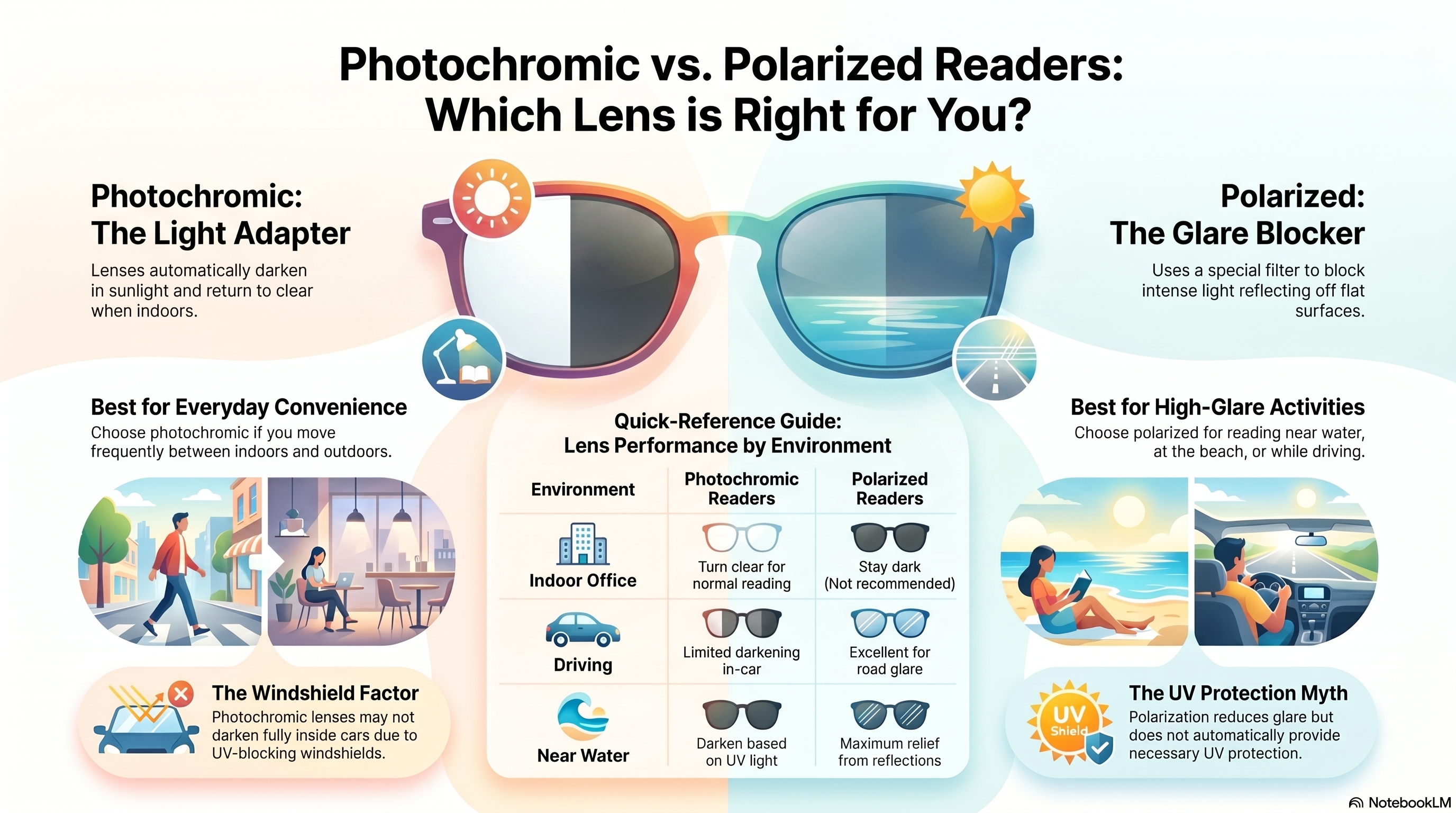
The simple difference is this: photochromic lenses adjust to light. Polarized lenses manage glare.
Why does this difference matter for readers?
Reading glasses are not only used indoors at a quiet desk. Many people use readers while checking a phone outside, reading a menu on a patio, looking at a map while traveling, checking labels at an outdoor market, or reading a book near a window.
That is where the lens choice matters. One person may need convenience when moving between indoor and outdoor spaces. Another may need relief from harsh glare while driving, walking near water, or sitting in bright sun.
The American Academy of Ophthalmology explains that photochromic lenses automatically darken in bright sunlight and return to a regular tint in normal environments. That makes them especially appealing for people who dislike switching between regular readers and sunglasses.
How do photochromic reading glasses work?
Photochromic lenses contain light-sensitive technology that reacts to sunlight. When you step outdoors, the lenses darken. When you return indoors, they gradually lighten again.
This makes photochromic readers helpful for everyday transitions, such as walking outside to get the mail, reading on the porch, shopping in and out of stores, or traveling between bright outdoor spaces and indoor rooms.
They are especially useful if you like the idea of one pair that feels more flexible throughout the day. You do not have to remember a separate pair of reading sunglasses every time you step outside.
How do polarized reading glasses work?
Polarized lenses use a special filter that helps block intense reflected light. This reflected light is what creates harsh glare from flat or shiny surfaces.
The American Academy of Ophthalmology notes that polarized lenses reduce glare and eyestrain, which can improve vision and safety in bright sun. For readers, that can make outdoor reading feel calmer and less washed out.
Polarized readers may be especially helpful when you are reading outside near water, sitting on a bright patio, driving during sunny conditions, or looking at printed material where glare keeps bouncing back at your eyes.
What are the key benefits of photochromic readers?
Photochromic readers are all about convenience and changing light.
- They adapt automatically. The lenses darken outdoors and become clearer indoors.
- They reduce switching. You may not need to carry separate indoor readers and reading sunglasses.
- They are helpful for errands. They work well when you move in and out of stores, cars, homes, and outdoor areas.
- They feel practical for travel. One adaptable pair can be easier to manage than multiple pairs.
- They can feel more natural for everyday use. They are not always dark, so they may feel less like traditional sunglasses indoors.
What are the key benefits of polarized readers?
Polarized readers are all about glare control.
- They reduce reflected glare. This helps when light bounces off water, pavement, cars, windows, or outdoor tables.
- They can make outdoor reading more comfortable. Print may feel less washed out in bright sun.
- They are helpful for driving. They may reduce glare from roads and windshields.
- They are useful near water. Reflections from pools, lakes, beaches, or boats can feel less intense.
- They may feel clearer in bright outdoor settings. Glare reduction can make surroundings look more comfortable and defined.
Is photochromic or polarized better for driving?
For driving, polarized readers are often better if glare is your main issue. They can help reduce bright reflections from roads, cars, and windshields.
Photochromic lenses may not darken as strongly inside some vehicles because many car windshields already block some of the UV light that activates the lens. That does not mean photochromic readers are not useful. It simply means they may not behave the same way inside a car as they do outdoors in direct sunlight.
If you mostly need help reading your phone, map, dashboard, or printed directions in bright driving conditions, polarized readers may feel more consistent. If you want one pair for walking in and out of the car during errands, photochromic readers may still be more convenient.
Is photochromic or polarized better for reading outside?
It depends on what bothers you more: changing light or reflected glare.
Choose photochromic readers if you move between indoors and outdoors often. They are practical for porch reading, patio lunches, quick errands, and everyday moments when light keeps changing.
Choose polarized readers if outdoor glare is the main problem. They may feel better for reading near water, relaxing at the beach, sitting beside a pool, reading in a bright car, or using readers in sunny outdoor settings.
Do polarized lenses protect your eyes from UV light?
Not automatically. This is one of the biggest points people misunderstand.
Polarization reduces glare, but it is not the same thing as UV protection. The American Academy of Ophthalmology recommends choosing sunglasses that block 99% to 100% of UVA and UVB rays, and explains that polarized lenses reduce reflected glare but do not automatically provide UV protection.
So if you choose polarized readers, look for lenses that also include proper UV protection. Glare comfort and UV protection are related to outdoor eye comfort, but they are not the same feature.
Are there downsides to photochromic reading glasses?
Photochromic readers are convenient, but they are not perfect for every situation.
- They may take a little time to darken or clear.
- They may not darken as much inside a car.
- They respond to light conditions, not specifically to glare.
- They may not be dark enough for someone very sensitive to bright sun.
Photochromic readers are best when your main need is convenience across changing light, not maximum glare reduction.
Are there downsides to polarized reading glasses?
Polarized readers are excellent for glare, but they also have limits.
- They stay tinted, even when you go indoors.
- They may make some digital screens harder to see from certain angles.
- They reduce glare, but do not automatically mean UV protection.
- They may be more specific to outdoor use than all-day indoor-outdoor use.
Polarized readers are best when your main frustration is glare, not moving between changing light environments.
Who are photochromic readers best for?
Photochromic reading glasses may be best for people who want flexible readers for everyday life.
They may be a good fit if you:
- Move between indoors and outdoors often
- Forget to bring separate reading sunglasses
- Read on the porch, patio, or near windows
- Want transition reading glasses for errands or travel
- Prefer one adaptable pair over multiple pairs
Who are polarized readers best for?
Polarized reading glasses may be best for people who are bothered by bright glare more than changing light.
They may be a good fit if you:
- Read outside in bright sun
- Spend time near water, patios, pools, or beaches
- Drive often in sunny conditions
- Find glare more uncomfortable than brightness itself
- Want outdoor readers that feel more like sunglasses
Can DebSpecs help you choose the right outdoor readers?
Yes. DebSpecs helps make lens choices feel easier by separating what each feature actually does. If you are comparing light-adaptive lenses, glare-reducing lenses, anti-glare coatings, blue light options, or polarized readers, the best choice depends on when and where your eyes feel uncomfortable.
For a clearer breakdown of common lens features, read DebSpecs’ guide to Lens Tech: Blue Light vs Anti-Glare vs Polarized. If you spend a lot of time outside, you may also find Why You Need Sunglasses for Outdoor Activities helpful for understanding comfort, glare, and sun protection.
The goal is not to choose the most technical lens. It is to choose the feature that solves your most common problem.
FAQs about photochromic vs polarized reading glasses
Are photochromic readers the same as polarized readers?
No. Photochromic readers change tint in sunlight. Polarized readers reduce reflected glare. Some lenses may combine features, but the terms do not mean the same thing.
Are transition reading glasses good for driving?
They can be useful for general indoor-outdoor convenience, but they may not darken as strongly inside some vehicles. If driving glare is your main issue, polarized readers may feel more consistent.
Are polarized readers good for reading outside?
Yes, especially if glare from water, pavement, cars, or bright outdoor surfaces makes text harder to see. They are particularly helpful in sunny, reflective settings.
Which is better for everyday use, photochromic or polarized?
Photochromic readers are usually better for everyday indoor-outdoor convenience. Polarized readers are usually better for bright outdoor glare.
Do I still need UV protection with polarized readers?
Yes. Polarization reduces glare, but it does not automatically provide UV protection. Look for readers or sunglasses that clearly include UVA and UVB protection for outdoor use.
The easiest way to choose
If your biggest frustration is switching glasses as you move in and out of the sun, photochromic reading glasses may be the more comfortable choice. If your biggest frustration is glare from roads, water, patios, or bright reflective surfaces, polarized readers may be the better option.
Both can make outdoor reading more comfortable. The right choice depends on whether your eyes need help adapting to light or cutting through glare.