


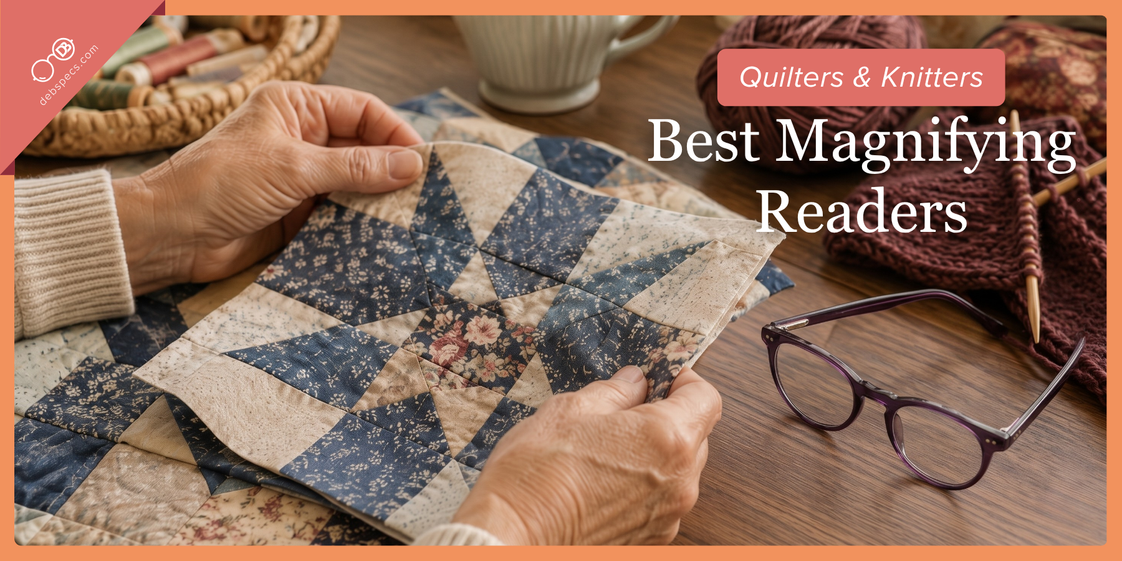
Quilters & Knitters: Best Magnifying Readers
Posted by Team Debby on 25th Jun 2026
Best Reading Glasses for Quilting and Knitting (2026)
TL;DR: The best reading glasses for quilting and knitting are the ones that match your working distance, give you enough magnification for stitches and patterns, and stay comfortable during long sessions. For many makers, that means a dedicated craft pair, sometimes slightly stronger than everyday readers, with good lighting and a stable, comfortable frame.
What are reading glasses for quilting and knitting?
Reading glasses for quilting and knitting are close-up readers chosen specifically for detailed handwork, such as seeing stitches, threading needles, reading patterns, matching fabric edges, and working with fine yarn.
They are not always the same pair you use for reading a book. Crafting often happens at a different distance, with your hands moving, your head angled down, and your eyes shifting between a pattern, fabric, yarn, needle, machine, or project surface.
That is why the right pair can feel like a small luxury in the sewing room. You are not just making print bigger. You are making the whole crafting experience calmer, clearer, and easier to enjoy.
When Detailed Work Needs Steadier Clarity
Quilting, knitting, and other close-up crafts often ask your eyes to follow small stitches, fine threads, and changing textures for long stretches of time. Readers designed for detailed near work can help bring that precision into focus with greater comfort, balance, and ease.
Why do quilters and knitters need different reading glasses?
Quilting and knitting ask your eyes to do a lot of close-up work. You may be reading tiny pattern symbols, counting rows, matching seams, checking stitch tension, tying knots, or threading a needle under changing light.
As near vision changes with age, those small details can become more tiring. The American Academy of Ophthalmology explains that presbyopia is the age-related loss of close-up focus, and reading glasses can help correct close-up vision problems by bending light before it enters the eye. You can read more in their guide to what presbyopia is.
Crafting can make these changes more noticeable because you are relying on fine detail for longer stretches. A pair that works for a restaurant menu may not be ideal for a dark navy yarn, tiny quilting stitch, or detailed chart.
How do magnifying readers help with needlework?
Magnifying readers help by making close details appear larger and easier to separate visually. For quilters, that may mean seeing seam allowances, stitch lines, thread color, and fabric patterns more clearly. For knitters, it may mean reading a chart, counting stitches, noticing dropped stitches, or working with finer yarn.
The important part is working distance. A stronger reader does not simply make everything better. It usually brings your clear viewing zone closer. If the strength is too high, you may need to hold your work uncomfortably close. If it is too low, you may still squint.
The American Optometric Association notes that people may only need glasses for close work such as reading, computer work, sewing, or other close tasks, depending on their presbyopia needs. Their overview of presbyopia and close work helps explain why different activities can call for different visual support.
What should you look for in quilting and knitting readers?
The best glasses for knitting and quilting should support both clarity and comfort. You want to see the detail without fighting the frame, the lens, or your posture.
- The right strength: Choose enough magnification for stitches and pattern details, but not so much that you have to hunch over.
- Comfortable working distance: Test where your hands naturally sit when quilting, knitting, crocheting, or sewing.
- A stable frame: Glasses should stay put when you look down, lean forward, or move between tools.
- A wide enough lens area: Full readers can feel easier for crafts because the whole lens helps with close-up work.
- Good lighting compatibility: Readers work best when your project is well lit, especially with dark fabric or fine yarn.
- A frame you enjoy wearing: If you craft for hours, the pair should feel like part of your routine, not a bother.
What strength reading glasses are best for quilting?
The best strength for quilting depends on how close your work is to your eyes. Hand quilting, applique, embroidery, and tiny piecing may need more magnification than casual reading. Machine quilting may require a strength that works at a slightly farther distance.
A helpful starting point is to compare your everyday reader strength with your quilting position. If your book readers are clear at normal reading distance but your quilt block sits closer, a slightly stronger pair may help. If your sewing machine needle or fabric bed sits farther away, a lower or task-specific strength may feel better.
A simple quilting guide:
- For pattern reading: your usual reading strength may be enough.
- For hand stitching: a slightly stronger close-work pair may help.
- For machine sewing: choose a strength that matches the distance to the needle and fabric bed.
- For dark thread or tiny detail: stronger readers plus good lighting may be more comfortable than strength alone.
What strength reading glasses are best for knitting?
Knitting readers should help you see both the yarn and the pattern without forcing your head into an uncomfortable angle. If you knit with your hands in your lap, your working distance may be different from someone who knits at a table.
Fine-gauge knitting, dark yarn, lace charts, and small needles often call for clearer magnification. Chunkier yarn or simple patterns may not require as much.
Warby Parker’s 2026 guide to glasses for crafts and hobbies makes a helpful point: craft eyewear should be chosen around the specific activity and preferred working distance, not just the general idea of “reading.”
Are stronger readers always better for crafts?
No. Stronger readers are only better if they match your working distance. Too much power can make your clear zone feel too close and too narrow, which may lead to hunching, neck strain, or frustration.
This is why many makers do better with a dedicated craft pair rather than simply buying the strongest readers available. The goal is not maximum magnification. The goal is comfortable clarity.
If you regularly need very strong magnification, you may also want to compare readers with other tools, such as a stand magnifier, lighted magnifier, or specialty low-vision device. The American Academy of Ophthalmology explains that magnifying spectacles and other assistive devices can support close tasks such as reading and threading a needle in their guide to low vision assistive devices.
What are the benefits of dedicated craft readers?
A dedicated pair of crafting readers can make your favorite hobbies feel more relaxed and less visually tiring.
- Clearer stitch definition: Easier to see loops, seams, thread paths, and fabric edges.
- Less squinting: Helpful when working with dark fabrics, fine yarn, or small pattern symbols.
- Better hands-free focus: Unlike a handheld magnifier, readers leave both hands available.
- More comfortable posture: The right strength can help you avoid leaning too close to your work.
- A smoother creative flow: Less stopping, checking, rechecking, and losing your place.
What are the downsides or common mistakes?
The biggest mistake is assuming one pair can do every task perfectly. Your book distance, phone distance, sewing machine distance, and knitting distance may not all be the same.
Common craft-reader mistakes:
- Buying the strongest pair without testing distance
- Using dim lighting and expecting glasses to solve everything
- Wearing loose readers that slide when you look down
- Using bifocals when a full-lens reader would give a wider close-up field
- Ignoring eye strain, headaches, or blur that does not improve with readers
If your eyes feel tired quickly, or if your vision has changed suddenly, it is worth checking in with an eye care professional rather than guessing your way through stronger and stronger readers.
Are full readers, bifocals, or magnifiers better for quilting and knitting?
Each option has a place. The best choice depends on how you craft.
- Full readers: Often best for long close-up craft sessions because the entire lens supports near work.
- Bifocals: Helpful if you often look up and down between your project and the room, but the reading zone may feel smaller for detailed work.
- Progressives: Useful for multiple distances, though some crafters prefer a wider, dedicated near zone for handwork.
- Stand or lighted magnifiers: Helpful when you need more magnification than glasses alone can comfortably provide.
For many quilters and knitters, a full-lens craft reader is the simplest choice because it gives a wide close-up area without needing to find a small segment at the bottom of the lens.
Who are quilting and knitting readers best for?
Dedicated craft readers are especially helpful for makers who rely on close-up detail and want their hobby to feel easier on the eyes.
- Quilters matching seams, cutting pieces, or hand stitching
- Knitters reading charts, counting stitches, or working with fine yarn
- Crafters who already wear readers but still squint during projects
- People who prefer hands-free magnification over handheld magnifiers
- Makers who want one pair to live in the sewing basket, project bag, or craft room
If you need a roomier fit for long crafting sessions, DebSpecs’ guide to Big Readers for Big Men may also help you think through frame width, comfort, and fit.
Who may not need special craft readers?
You may not need a separate pair if your everyday readers already work well at your crafting distance, your sessions are short, or you mostly use large needles, thick yarn, simple patterns, or high-contrast materials.
You may also need a more customized option if you have astigmatism, very different vision between your two eyes, cataracts, macular changes, or any condition that makes standard readers feel unclear. In those cases, an eye exam can help you avoid choosing glasses that do not truly solve the problem.
Can DebSpecs help with reading glasses for quilting and crafts?
Yes. DebSpecs offers reading glasses for real-life close work, including crafting, sewing, quilting, knitting, embroidery, and other detail-heavy hobbies. The goal is to help you find a pair that feels practical, comfortable, and clear enough for the work you love.
You can explore DebSpecs’ dedicated page for Reading Glasses for Crafting & Sewing Detailed Work, or continue with The Science of Sight: Choosing the Right Glasses for Intricate Crafts for a deeper look at how readers support detailed projects.
FAQs about reading glasses for quilting and knitting
What are the best reading glasses for quilting?
The best quilting readers are comfortable full-lens readers that match your working distance. They should help you see seams, stitches, fabric edges, and patterns clearly without forcing you to lean too close.
What are the best glasses for knitting?
The best knitting glasses make it easier to see stitches, yarn texture, rows, and charts at the distance where your hands naturally rest. Fine yarn and dark colors may need stronger magnification or better lighting.
Should craft readers be stronger than regular readers?
Sometimes. If your craft work sits closer than a book, a slightly stronger pair may help. If your work sits farther away, such as at a sewing machine, a lower or task-specific strength may feel better.
Are bifocals good for knitting and quilting?
Bifocals can help if you move between close work and looking across the room. For long, detailed craft sessions, some people prefer full readers because the whole lens supports close-up viewing.
Do I need a lighted magnifier instead of reading glasses?
A lighted magnifier may help if readers alone do not provide enough detail, especially for very fine work or low vision. Many makers use both: readers for normal close work and a magnifier for the smallest details.
The right craft readers help you stay with the work you love
Quilting and knitting are more than hobbies. They are rhythm, memory, creativity, patience, and comfort. The right reading glasses help protect that joy by making the small details easier to see.
Choose your readers around your real working distance, your materials, your lighting, and the way your hands naturally move. Stronger is not always better. Clearer and more comfortable is the goal.
With the right pair nearby, you can spend less time squinting at the stitches and more time enjoying the quiet satisfaction of making something beautiful by hand.