



Why Your Reader Strength Changes Faster After Menopause
Posted by Team Debby on 26th May 2026
Menopause and Reading Glasses: Why Strength Changes Faster
TL;DR
If your reading glasses strength seems to change faster during perimenopause or after menopause, you are not imagining it. Presbyopia, dry eyes, hormone shifts, screen fatigue, and changing tear quality can overlap in your 40s, 50s, and beyond, making your readers feel “wrong” sooner than they used to.
Finding Steadier Support as Vision Changes
When reader strength starts to feel less predictable during menopause, the answer is not always a big jump in power. These reader options are designed to help you adapt more comfortably, with support that considers changing clarity, everyday reading distance, and the need for a steadier close-up experience.
Why can menopause affect reading glasses strength?
Menopause reading glasses change happens when normal age-related near vision changes overlap with hormonal shifts that may affect eye comfort, dryness, focus, and how clear your readers feel day to day.
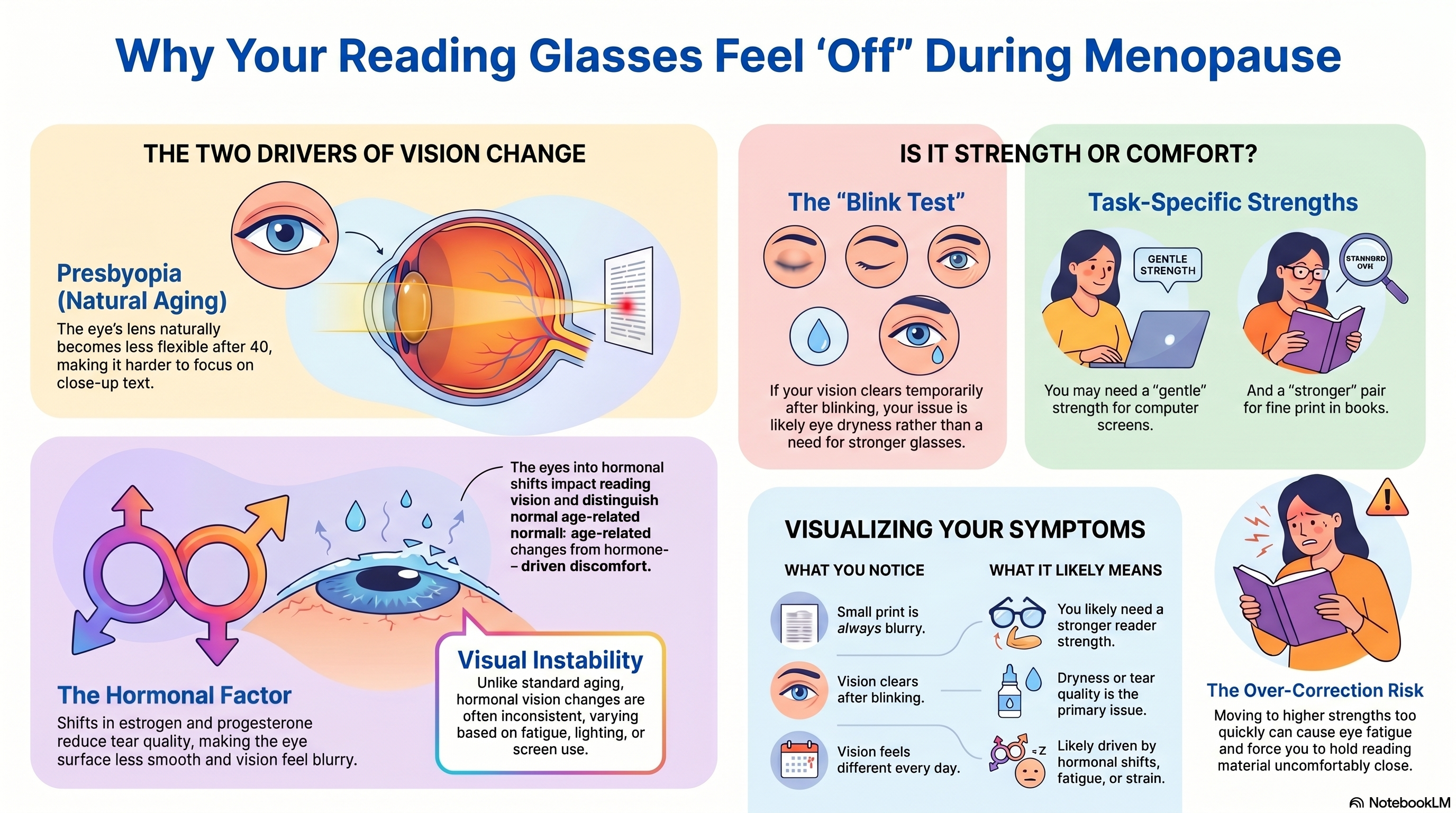
Menopause does not usually create presbyopia by itself. Presbyopia is the natural loss of close-up focusing ability that typically begins in your 40s. But menopause and perimenopause often arrive around the same time, which can make vision changes feel faster, more noticeable, and more frustrating.
The American Academy of Ophthalmology explains that presbyopia happens because the eye’s natural lens becomes less flexible with age. When that change combines with dryness, fluctuating comfort, and longer screen days, your usual readers may suddenly feel weaker than expected.
Why does this matter in everyday life?
This matters because the change often shows up during small, ordinary moments.
You may notice that your phone text feels blurry at night, recipes need brighter light, or your favorite +1.75 readers suddenly do not feel strong enough. You may move up to +2.00, then wonder why that pair also feels inconsistent a few months later.
For many women, the frustrating part is not only the strength number. It is the feeling that your eyes are no longer predictable. One day your readers work beautifully. The next day, your eyes feel dry, tired, or slow to focus.
That is why menopause-related reader changes are best understood as a mix of focus, comfort, moisture, and daily habits, not just a simple jump from one diopter to the next.
How do hormones affect your eyes during perimenopause and menopause?
Hormones can influence more than hot flashes and sleep. They can also affect the way your eyes feel and function.
Estrogen and other hormone changes may affect tear production, tear quality, and eye surface comfort. The American Academy of Ophthalmology notes that hormones can play a role in vision changes throughout adult life, including during menopause.
When your eyes are dry or irritated, text can look less crisp. You may blink more, squint more, or feel like your glasses are not doing their job. In some cases, the issue is not that your reader strength is suddenly too weak. It may be that the surface of your eyes is not comfortable enough to give you steady, clear vision.
How does dry eye make readers feel weaker?
Dry eye can make your vision fluctuate. That means your readers may feel clear one moment and blurry the next.
A healthy tear film helps create a smooth surface over the eye. When that tear film is unstable, light does not pass through as cleanly. The result can feel like smudged lenses, even when your glasses are perfectly clean.
The Mayo Clinic lists menopause-related hormonal changes and age over 50 as risk factors for dry eyes. That is one reason reading glasses may feel less reliable during this stage of life.
You may notice dry-eye related blur more when you are:
- Reading on a phone or tablet for a long time
- Working at a computer without blinking often
- Reading in air conditioning, wind, or dry indoor air
- Trying to read at night when your eyes are already tired
- Switching between screens, paperwork, and close-up tasks
How does presbyopia change during this same stage?
Presbyopia usually becomes more noticeable through your 40s and 50s. This is the same window when many women are moving through perimenopause or menopause.
That timing can make it feel like menopause is directly changing your reader strength every few months. In reality, two things may be happening at once: your near focus is naturally changing with age, and your eyes may also feel drier or more sensitive because of hormonal shifts.
This combination can make the difference between +1.50 and +1.75, or +2.00 and +2.50, feel more dramatic than it did before.
What are the signs your reader strength may actually need updating?
Sometimes your readers feel wrong because your eyes are dry or tired. Other times, your strength really may need to move up.
Your reader strength may need updating if:
- Small print stays blurry even after you blink or rest your eyes
- You keep holding reading material farther away
- You need noticeably brighter light than before
- Your current readers work only for very short periods
- You squint even when your glasses are clean
- Your usual strength no longer feels clear at your normal reading distance
A small step up, such as moving from +1.75 to +2.00 or from +2.00 to +2.25, may be enough. You usually do not need to jump dramatically unless your close-up tasks truly require it.
What are the signs dryness or fatigue may be the real issue?
If your readers feel inconsistent instead of simply weak, dryness or fatigue may be part of the problem.
Dryness may be involved if:
- Your vision clears briefly after blinking
- Your eyes feel gritty, watery, burning, or tired
- Your readers work better in the morning than at night
- Screens make your eyes feel worse
- The blur seems to come and go during the day
In this case, buying stronger readers may help a little, but it may not solve the root issue. You may need better lighting, more breaks, artificial tears, a screen-distance adjustment, or an eye exam to check what is happening.
Are stronger readers always the answer after menopause?
No. Stronger readers can be helpful when your close-up focus truly needs more support, but they are not always the best first answer.
If the strength is too high, your ideal reading distance may become too close. You may feel pulled into the page, uncomfortable looking up, or unable to use the glasses for anything beyond very close print.
The better approach is to ask what has changed. Is print blurry at every time of day, or only at night? Is it worse after screen use? Does blinking help? Does the problem happen with books, phones, computers, or all three?
Those answers can help you decide whether to adjust your strength, your reading habits, or both.
What are the benefits of tracking reader strength during menopause?
Tracking your reader strength can make vision changes feel less confusing. Instead of guessing, you begin to see patterns.
- You notice whether the change is steady or sudden. Gradual changes are common, while sudden changes deserve more attention.
- You avoid jumping too strong too quickly. A small increase may be more comfortable than skipping several strengths.
- You can separate dryness from true strength needs. If vision fluctuates, the problem may not be the diopter alone.
- You choose readers for real tasks. Phone, books, computers, crafts, and cooking may not all need the same strength.
- You feel more confident replacing old pairs. You know why you are moving up instead of guessing.
How often should you update reading glasses after menopause?
There is no single schedule that fits everyone. Many people notice reader strength changes every few years during the strongest years of presbyopia progression. Others feel changes sooner because dryness, lighting, screen use, or health changes make their vision feel less stable.
A good practical rule is to reassess your readers when they no longer feel clear at your normal reading distance. That does not always mean buying stronger glasses immediately. It means checking your comfort, your tasks, your lighting, and whether the blur is steady or fluctuating.
You can use the DebSpecs guide How Often to Update Reader Strength to understand what is typical and when it may be time to compare your current strength with the next step up.
Who is most likely to notice faster reader changes during menopause?
You may notice faster or more frustrating reader changes if you are in your 40s, 50s, or early 60s and already dealing with near-vision strain.
This may be especially true if you:
- Use screens for long stretches of the day
- Read at night or in softer lighting
- Have dry, watery, or irritated eyes
- Switch between phone, computer, paperwork, and close tasks
- Have recently moved up in reader strength but still feel inconsistent
- Notice that your vision changes throughout the day
If your changes feel sudden, one-sided, painful, or accompanied by flashes, floaters, or new headaches, it is best to contact an eye care professional rather than simply increasing your reader strength.
Can DebSpecs help you choose readers during menopause?
Yes. The best reader choice during menopause is usually the one that matches your real life, not just your age.
If you are noticing new changes, start with a calm comparison of your current strength and the next small step up. Pay attention to when the blur happens, how long you read, and whether your eyes feel dry or tired.
For more guidance, you can explore DebSpecs’ related articles: The Surprising Link Between Menopause and Vision Changes, 5 Eye Health Myths Busted, and How Often to Update Reader Strength.
The goal is not to chase a higher number. It is to find the reader strength that gives you clear, comfortable support for the way your eyes feel now.
FAQs about menopause and reading glasses changes
Can menopause make my reading glasses prescription change?
Menopause does not usually cause presbyopia by itself, but hormonal changes can affect eye comfort and dryness. When this overlaps with age-related near vision changes, your readers may feel like they need updating faster.
Why do my readers work some days but not others?
Fluctuating clarity can happen when dryness, fatigue, screen use, or lighting changes affect your eyes. If blinking or resting your eyes temporarily improves vision, dryness may be part of the issue.
Should I move up to stronger readers after menopause?
You may need stronger readers if close-up text stays blurry at your normal reading distance. But if your vision comes and goes, or your eyes feel dry and irritated, it may help to address eye comfort before jumping to a much stronger strength.
Can dry eyes make reading glasses seem wrong?
Yes. Dry eyes can blur or fluctuate your vision, which may make your readers feel too weak even when the strength is close to correct.
When should I get an eye exam instead of buying new readers?
Schedule an eye exam if your vision changes suddenly, one eye is much blurrier, you have pain, flashes, new floaters, frequent headaches, or if readers no longer help clearly at any strength.
A calmer way to understand changing reader strength
Reader strength changes after menopause can feel frustrating, but they are often easier to understand once you separate focus from comfort. Your eyes may need a new diopter, better moisture support, better lighting, or a different pair for a different task.
The most reassuring place to start is simple: notice when your readers stop working well, compare small strength changes carefully, and pay attention to how your eyes feel. Clear vision is not only about the number on the frame. It is about comfort, consistency, and choosing support that fits this stage of life.