


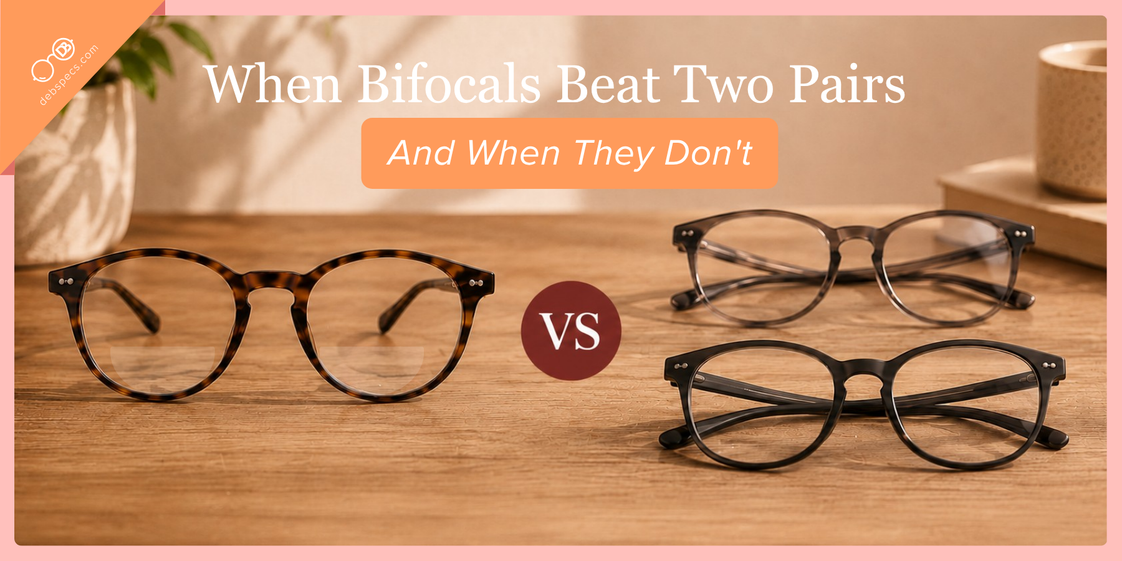
When Bifocals Beat Two Pairs (And When They Don't)
Posted by Team Debby on 25th Jun 2026
Bifocals vs Two Pairs of Reading Glasses: An Honest Comparison
TL;DR: Bifocals are often better when you are tired of switching between glasses and want one pair for distance and reading. Two pairs may still be better if you only read occasionally, need different strengths for different tasks, or prefer a wider full-lens reading area.
What is the difference between bifocals and two pairs of reading glasses?
Bifocals combine two vision zones in one pair of glasses, usually a clear or distance area on top and a reading area at the bottom.
Two pairs of reading glasses means you use separate glasses for separate needs. For example, you may keep one pair for reading a book and another pair for computer work, crafting, cooking, or seeing small print at a different distance.
The simplest way to think about it is this: bifocals reduce switching, while two pairs give you more task-specific flexibility.
Finding the Right Solution for the Way You Read
The best choice depends on how you move through your day and the tasks you switch between most often. Thoughtfully designed bifocals and reading glasses each offer unique advantages, making it easier to find an option that supports your routine with greater comfort and convenience.
Why does this choice matter in real life?
Once near vision starts changing, glasses often become part of your daily routine. You may need them for your phone, menus, dashboard, recipes, medication labels, price tags, books, and laptop screens.
That is when the “one pair or two pairs” question becomes practical. It is not only about vision correction. It is about convenience, comfort, habits, and how often your day asks you to move between near and far.
Presbyopia, the age-related change that makes close-up focus harder, usually becomes noticeable around the 40s and continues gradually with age. Cleveland Clinic explains that bifocals are commonly used for presbyopia because they place two different prescriptions in one lens, with the reading portion typically in the lower part of the lens. You can read their overview of presbyopia and common treatment options.
How do bifocals work compared with regular readers?
Regular reading glasses usually have the same magnification across the entire lens. That is why they work so well when you are looking down at a book, phone, label, or recipe.
But when you look up across the room while wearing full readers, things in the distance may look blurry. That is the moment many people slide the readers down their nose, take them off, put them on their head, or switch to another pair.
Bifocals solve that problem by giving you a reading zone at the bottom while keeping the upper part of the lens available for distance or non-reading vision. Some bifocals have a visible line. Others are designed to look more subtle. If you are curious about the style difference, DebSpecs explains this further in Hidden Bifocals.
When are bifocals better than two pairs of readers?
Bifocals usually win when your biggest frustration is constant switching.
- You look up and down often: Bifocals help when you move between near tasks and the room around you.
- You drive and need to see the dashboard: A bifocal can help with close dashboard details while keeping the top area clearer for distance.
- You lose readers easily: One dependable pair can be simpler than keeping separate glasses in every room.
- You dislike taking glasses on and off: Bifocals can feel smoother during errands, work, travel, and conversations.
- You want less visual clutter: Fewer pairs on your desk, nightstand, purse, and car can make life feel simpler.
This is where bifocals can feel quietly freeing. You are not constantly hunting for the “right” pair. You simply wear one pair that handles more than one part of your day.
When are two pairs of reading glasses better?
Two pairs still make sense for many people. Bifocals are useful, but they are not automatically the best choice for every task.
- You only need readers occasionally: If you use reading glasses for short moments, a simple pair may be enough.
- You need a wide reading area: Full-lens readers can feel easier for long reading sessions, sewing, puzzles, or detailed close work.
- You use different distances: Computer work may need a different strength than book reading or fine print.
- You do not like looking through zones: Some people prefer the simplicity of one power across the whole lens.
- You want backup pairs: Having a pair in the kitchen, car, office, and bedroom can be convenient.
Two pairs can also work well if your day is very task-based. For example, one pair may live at your desk for screen distance, while another stays by your favorite chair for books.
Are bifocals worth it?
Bifocals are worth it if they solve a problem you feel every day. The value is not just in having two powers. It is in reducing the little interruptions that happen when you constantly remove, replace, or search for glasses.
They can be especially worthwhile if you are already thinking, “I need one pair for life, not five pairs scattered everywhere.”
The American Academy of Ophthalmology explains that bifocal and trifocal lenses use separate magnification levels, while progressives offer a gradual, line-free change between powers. Their guide to progressive lenses and computer glasses is helpful if you are comparing all multifocal options.
What are the downsides of bifocals?
Bifocals can be wonderfully practical, but they do take some adjustment.
- The reading area is smaller: You may not get the same wide close-up view as full readers.
- Your eyes need to learn the zones: You look through the top for distance and the bottom for reading.
- Stairs can feel different at first: Looking down through the reading portion may feel unusual until you adjust.
- They may not solve computer distance: A standard bifocal is usually built for distance and near, not always the middle distance of a laptop or desktop monitor.
- Some people notice the line: Lined bifocals are visible, though some styles look softer and more discreet.
None of these are dealbreakers for everyone. They are simply honest points to consider before choosing.
How do bifocals compare with progressives?
Bifocals and progressives both help with more than one viewing distance, but they feel different.
Bifocals usually have two clear zones: one for distance and one for reading. Progressives have a gradual change in power, so they can include distance, intermediate, and near vision without a visible line.
Ohio State Health notes that bifocals are different from progressives because bifocals typically correct distance and close reading, while progressives also support intermediate distances such as computer or dashboard viewing. Their explanation of progressive lenses versus bifocals gives a clear medical overview.
For a more DebSpecs-focused comparison, see Progressive vs Bifocal.
Who are bifocals best for?
Bifocals are often best for people who want one pair to move through a varied day.
- You read small print but also need to look across the room often.
- You want to see your dashboard, phone, or labels without removing your glasses.
- You are tired of readers living in every drawer and bag.
- You prefer a practical, easy-to-understand lens over a more complex progressive design.
- You want reading help without wearing full readers all day.
They are especially useful for people who move between conversation, errands, driving, shopping, and quick close-up tasks.
Who may be better with two pairs instead?
Two pairs may be the better choice if your needs are specific and separate.
- You read for long stretches and want the entire lens to be magnified.
- You work at a computer and need a dedicated intermediate strength.
- You do detailed hobbies that require a very specific working distance.
- You rarely need distance clarity while wearing readers.
- You prefer simple glasses with no zones or adjustment period.
Can custom bifocals help if regular readers are not enough?
Yes. Custom bifocals can be helpful when basic readers do not match the way you actually use your eyes. Some people want clear top lenses with magnification only at the bottom. Others may need a specific reading strength that is not easy to find in standard store-bought options.
DebSpecs offers bifocal and specialty reader options for different daily needs, including styles designed to be more practical, flattering, and comfortable than constantly juggling multiple pairs. You can also explore 10 Things You Didn’t Know About Bifocals for a deeper look at how bifocals can fit into everyday life.
FAQs about bifocals vs two pairs of reading glasses
Are bifocals better than reading glasses?
Bifocals are better if you need help seeing up close but also want clearer distance vision in the same pair. Regular readers are better if you only need magnification for close-up tasks.
When should I get bifocals?
Consider bifocals when you are constantly taking readers on and off, switching between near and far tasks, or needing reading help while driving, shopping, or moving through your day.
Are bifocals hard to get used to?
They can take a little time. Most people need to learn where to look for reading versus distance. The adjustment is usually easier when the lens strength and frame fit are right.
Are progressives better than bifocals?
Progressives may be better if you need distance, computer, and reading support in one line-free lens. Bifocals may be better if you prefer clear, simple zones for distance and reading.
Can I use two pairs instead of bifocals?
Yes. Two pairs can work beautifully if your tasks are separate, such as one strength for reading and another for computer work. The tradeoff is that you may need to switch more often.
The honest answer: choose the pair that fits your day
Bifocals beat two pairs when convenience matters most. They can make your day feel smoother by reducing the constant on-off, where-did-I-put-them rhythm of regular readers.
Two pairs beat bifocals when your tasks need a wider reading area, a very specific strength, or a dedicated computer distance. Neither choice is wrong. The right choice is the one that supports how you actually read, work, drive, cook, shop, and move through life.
Good eyewear should feel helpful, not complicated. Once you understand the difference, choosing between bifocals and two pairs becomes less about rules and more about comfort, clarity, and confidence.